Best AI Agent Platform (2026)

If you sign up through a link on this page, we may earn a commission — it never affects our rankings.
A curated guide to the top AI agent platforms for building, deploying, and orchestrating autonomous agents that handle multi-step tasks, tool use, and workflow automation.
AI Agent Platform by the numbers
Pricing mix
Best AI Agent Platform (2026)
- 1
 AI Agents DirectoryA curated marketplace for discovering and comparing AI agents across business use cases.5.0 (4)
 - 2
 SkyworkAgent-driven workspace for docs, slides, sheets, images, and multimedia content4.8 (4)
 - 3
 Nanobanana 2AI image generator focused on 4K detail, legible in-image text, and consistent subjects across scenes.4.7 (6)
 - 4
 LLMStackOpen-source platform for building AI agents and applications with custom data, supporting diverse LLM providers.4.7 (6)
 - 5
 Z-ImageAI-powered image generation and editing for creators who want fast, flexible visual results.4.5 (6)
 - 6
 TaskingAIA cloud platform for building, deploying, and managing LLM agents.4.5 (6)
 - 7AAthina AICollaborative AI development platform for building, testing, and monitoring AI features.4.5 (4)
- 8
 AI FrameAll-in-one AI creative studio for generating images, video, and content from a single workspace.4.5 (4)
AI Agents Directory
A curated marketplace for discovering and comparing AI agents across business use cases.
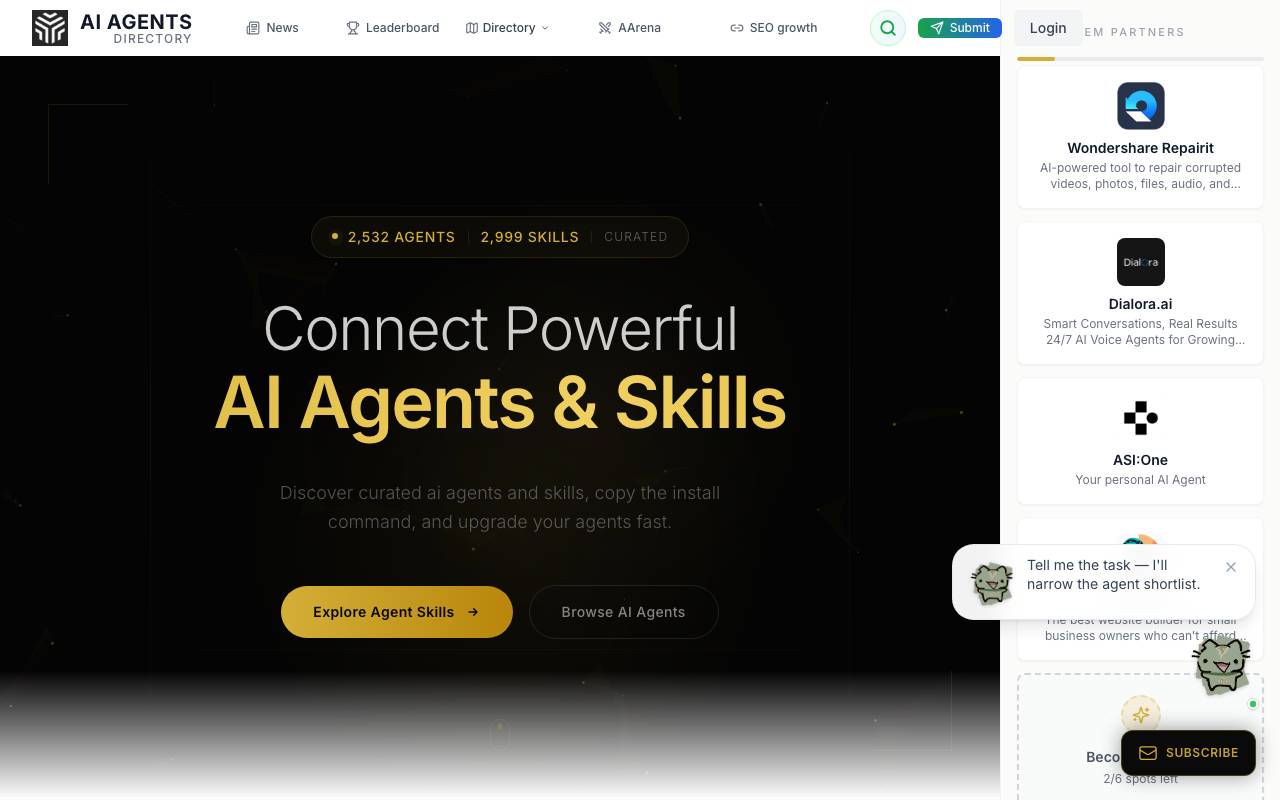
AI Agents Directory is a discovery platform that catalogs AI agents and autonomous tools from across the industry, helping businesses identify solutions that fit their workflows. With over 1,300 listings, it organizes agents by category, capability, and use case so teams can browse options without sifting through scattered vendor sites. The directory functions as a connection point between agent builders and potential users, offering structured listings, descriptions, and links to each tool. It is aimed at decision-makers, developers, and operators evaluating where AI agents can be applied in their organizations.
- 1,300+ AI agent listings
- Category and use-case browsing
- Search and filtering tools
- Profiles with descriptions and links
- Marketplace for builders and buyers
- Regular additions of new agents
Skywork
Agent-driven workspace for docs, slides, sheets, images, and multimedia content
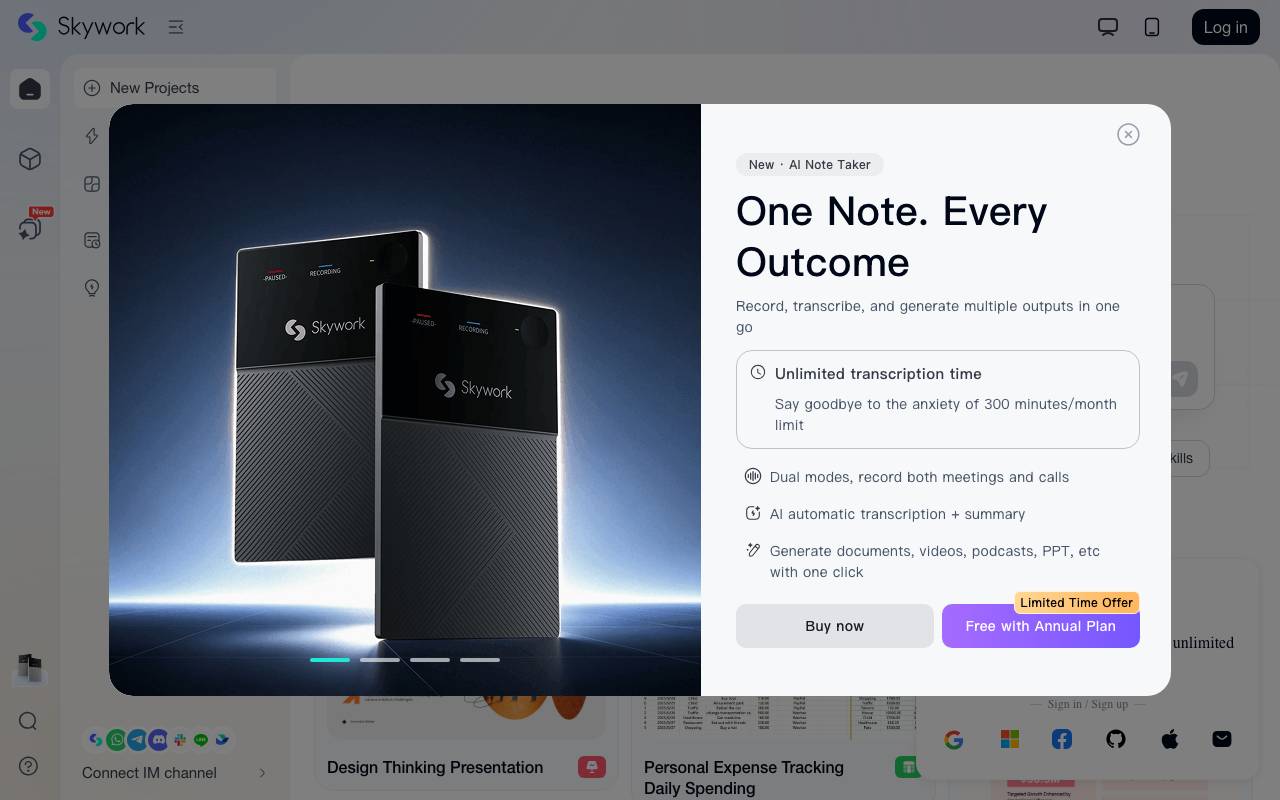
Skywork is an AI workspace platform designed to let intelligent agents collaborate across multiple content formats from a single interface. Instead of switching between separate apps for writing, presentations, spreadsheets, and visual media, users delegate tasks to agents that can produce and refine each output type within the same environment. The platform targets professionals who need to assemble multi-format deliverables, such as research reports paired with slide decks, data analyses with charts, or marketing materials that combine copy and visuals. Agents handle the heavy lifting of drafting, formatting, and iterating, while users guide direction and review results. By unifying document, image, slide, sheet, and multimedia workflows, Skywork aims to reduce context switching and streamline end-to-end content production for knowledge workers and small teams.
- AI agents for document creation
- Slide and presentation generation
- Spreadsheet and data handling
- Image and multimedia output
- Unified multi-format workspace
- Task delegation to autonomous agents
Nanobanana 2
AI image generator focused on 4K detail, legible in-image text, and consistent subjects across scenes.
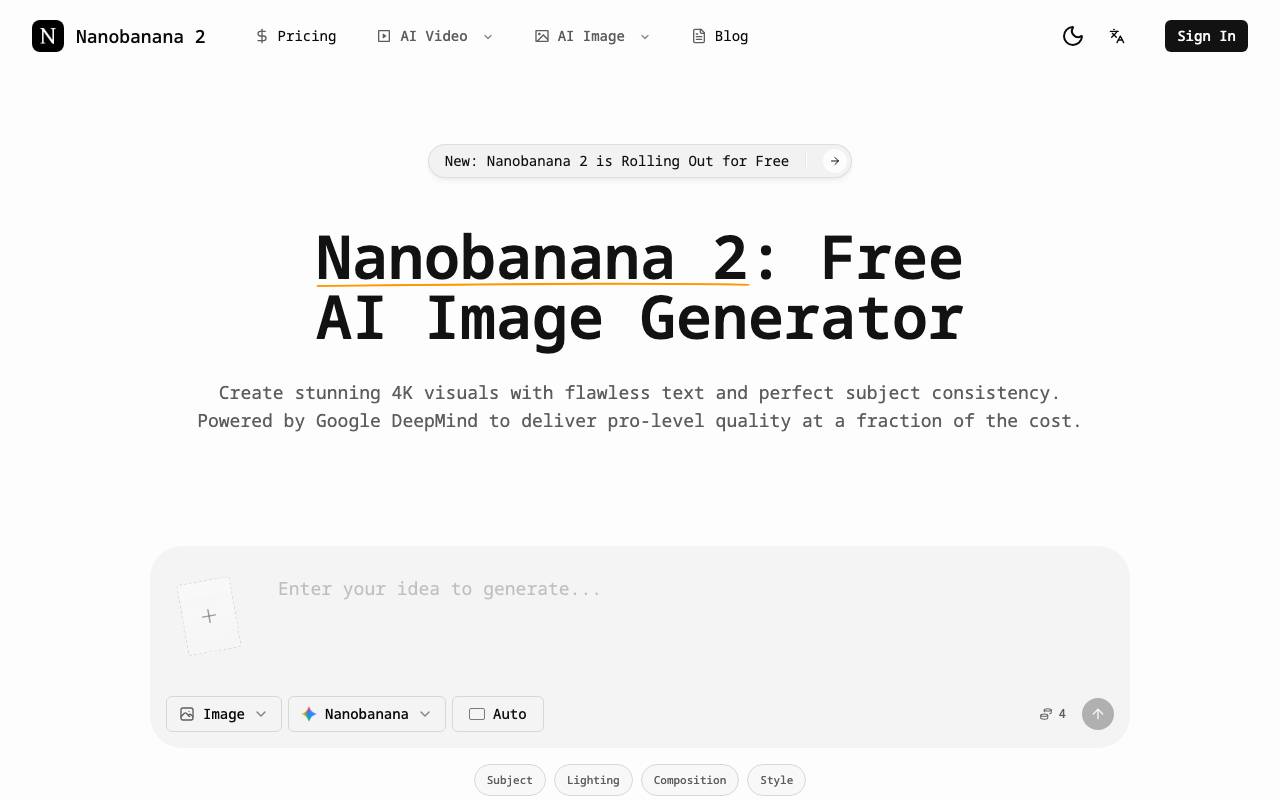
Nanobanana 2 is an AI image generation tool designed for users who need high-resolution visuals without sacrificing fine detail. It targets 4K output and emphasizes sharpness in textures, lighting, and small graphic elements that often break down in lower-quality generators. A key focus of the tool is readable text inside images, making it useful for posters, ads, product mockups, and social media graphics where typography matters. It also aims to keep subjects—characters, products, or brand elements—visually consistent across multiple generations, which helps with series, storyboards, and campaigns. The tool is positioned for designers, marketers, and content creators who want a faster path from prompt to publish-ready imagery.
- 4K image generation
- Readable text within images
- Consistent character and product subjects
- Prompt-based scene control
- Suitable for ads, posters, and social content
- Iterative refinement of generated images
LLMStack
Open-source platform for building AI agents and applications with custom data, supporting diverse LLM providers.
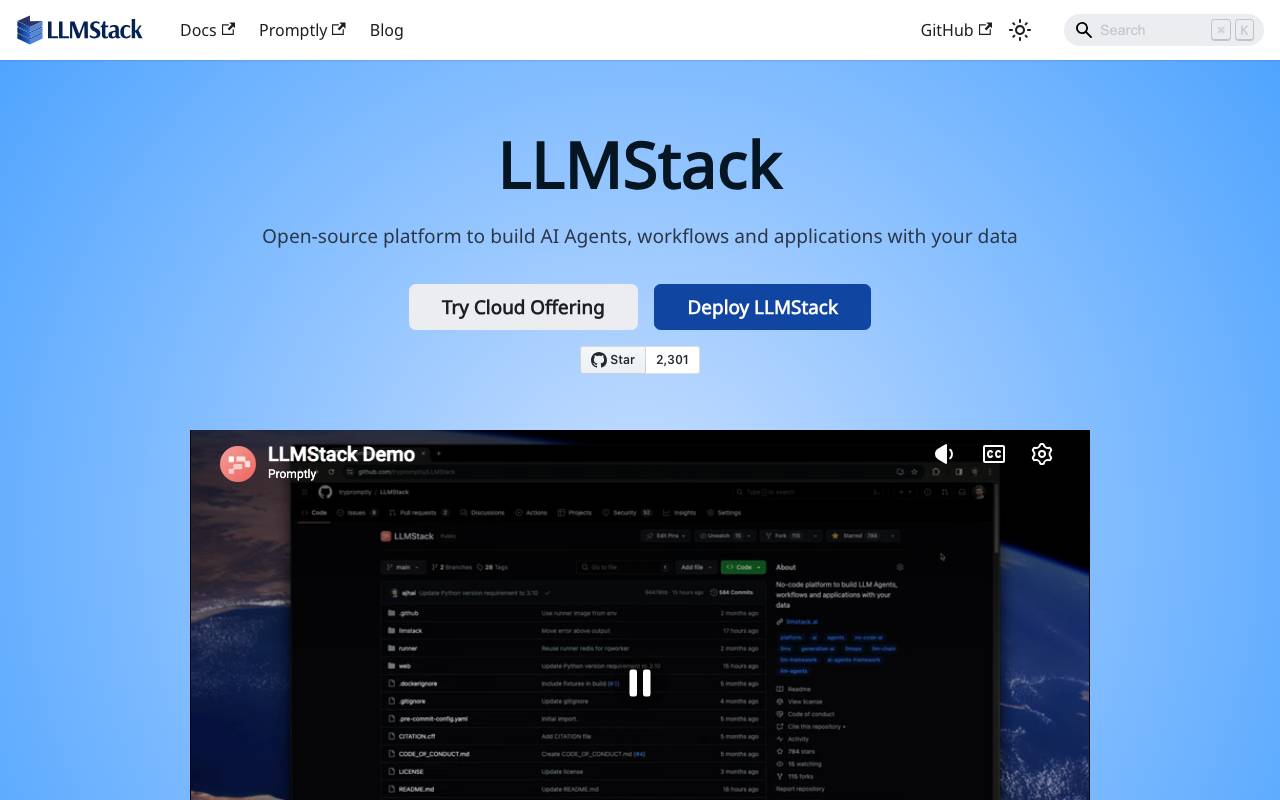
LLMStack is an open-source platform designed to facilitate the creation of AI agents, workflows, and applications. Its primary function is to enable users to integrate their proprietary data with large language models to build customized generative AI solutions. The platform addresses the challenge of securely and efficiently connecting enterprise or personal data to powerful AI models. It is built for developers and teams looking to leverage generative AI without starting from scratch, offering a structured environment to develop and deploy AI-powered tools. At its core, LLMStack supports a wide array of major LLM providers, including OpenAI, Cohere, Stability AI, and Hugging Face models, allowing users flexibility in choosing their underlying AI engine. A key capability is "Model Chaining," which suggests the ability to orchestrate multiple models or steps within an AI application. For data integration, LLMStack provides extensive support for importing and connecting various data sources. This includes common formats like Web URLs, Sitemaps, PDFs, Audio files, and PPTs, as well as integrations with services like Google Drive and Notion. This broad data ingestion capability is crucial for building Retrieval Augmented Generation (RAG) applications that can provide contextually relevant responses based on specific user data. Beyond building, LLMStack also emphasizes collaborative development and deployment. It allows multiple users to modify and build applications together through viewer and collaborator roles. Finished applications can be shared publicly or restricted to specific individuals using a granular permission model. While primarily offered as an open-source solution for self-deployment, the platform also indicates a "Cloud Offering" for those preferring a managed service.
- Open-source platform
- Model chaining functionality
- Integration with major LLM providers (OpenAI, Cohere, Hugging Face)
- Data import from Web URLs, PDFs, Audio, Google Drive, Notion
- Collaborative app building with roles
- Granular application access permissions
Z-Image
AI-powered image generation and editing for creators who want fast, flexible visual results.
Z-Image is an AI image tool designed to help users create, transform, and refine visuals from simple text prompts or existing pictures. It targets a broad audience, from social media creators and marketers to designers exploring concept art and product mockups. The platform focuses on accessibility, offering a streamlined interface where users can generate new images, restyle uploads, or iterate on results without deep technical knowledge. Outputs can be tuned through prompts and settings to match different styles, moods, and use cases. Whether the goal is a polished marketing asset, a creative experiment, or a quick edit, Z-Image aims to shorten the path from idea to finished image.
- Text-to-image generation
- Image-to-image transformation
- Style and mood customization
- Prompt-based editing
- Multiple aspect ratios
- Web-based access

TaskingAI is a cloud-native platform designed to assist developers in building, deploying, and managing AI agents powered by large language models (LLMs). It aims to abstract away much of the underlying complexity involved in moving AI-native applications from development to production environments. The platform provides a suite of tools for orchestrating agent behavior, which includes defining agent roles, managing conversational memory, and enabling agents to use external tools. Developers can integrate custom functions or APIs as tools, allowing agents to perform actions beyond basic text generation, such as querying databases, sending emails, or interacting with other services. Key capabilities extend to prompt management, offering features for templating, versioning, and A/B testing prompts to optimize LLM interactions. TaskingAI also supports the integration of knowledge bases, facilitating retrieval-augmented generation (RAG) by allowing agents to access and synthesize information from proprietary data sources. This helps ground LLM responses in factual, domain-specific information, reducing hallucinations. The platform is designed to be model-agnostic, supporting various commercial and open-source LLMs, providing flexibility for developers to choose models based on their specific needs and cost considerations. It includes functionalities for monitoring agent performance, usage, and costs, which are crucial for maintaining and scaling AI applications in production. TaskingAI positions itself as a managed backend for agent development, contrasting with standalone open-source libraries by offering an integrated environment for the entire agent lifecycle, from design to deployment and observation.
- LLM agent orchestration
- Prompt templating and versioning
- Custom tool integration
- Knowledge base connectors (RAG)
- Multi-model LLM support
- Agent monitoring and analytics
Athina AI
Collaborative AI development platform for building, testing, and monitoring AI features.
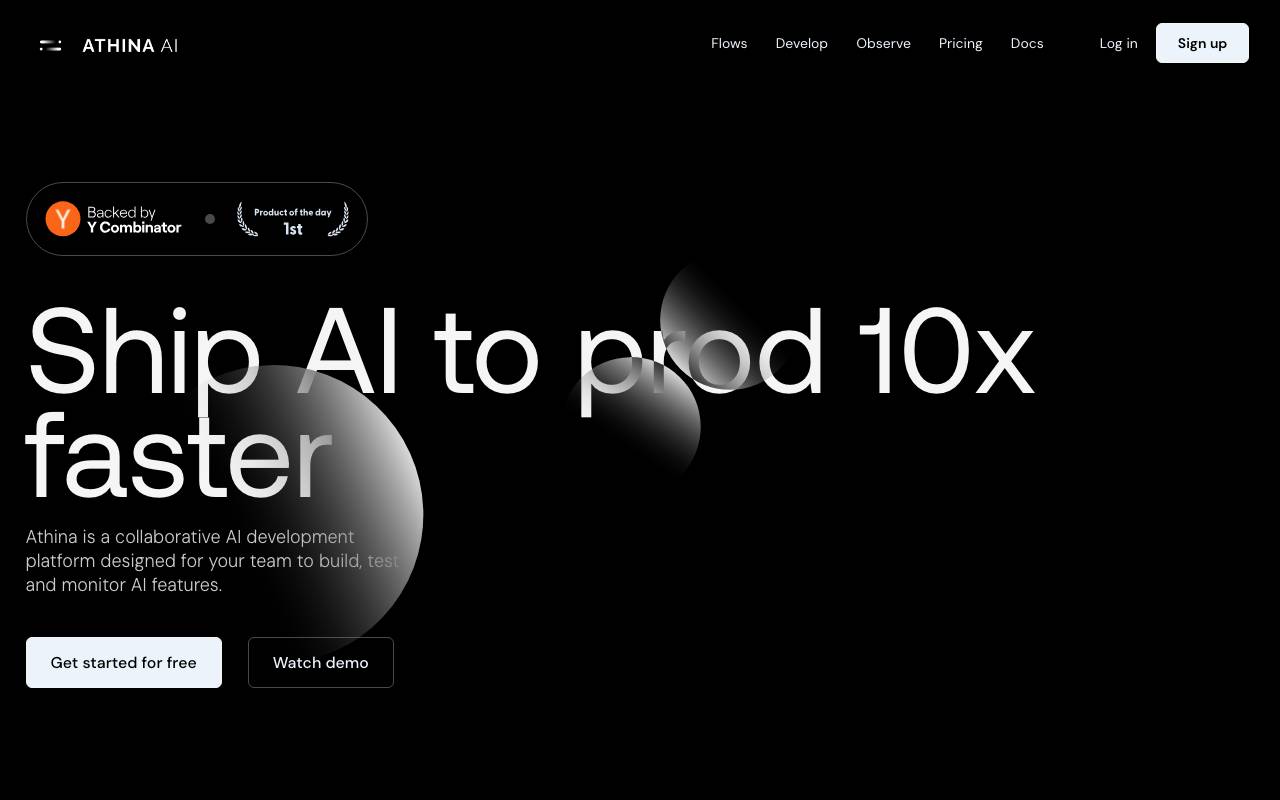
Athina is a collaborative AI development platform designed to help teams build, test, and monitor AI features, aiming to accelerate their shipment to production. The platform caters to various roles within an AI team, including data scientists, product managers, QA teams, and engineers, by providing tailored tools and interfaces. It enables both technical users, who can interact programmatically via SDKs and APIs, and non-technical users, who can leverage a no-code UI for tasks like building complex AI flows. Core capabilities include comprehensive prompt management, supporting various models including custom ones, along with features for testing and running prompts. It provides extensive dataset evaluation capabilities, offering over 50 preset evaluation metrics as well as options to configure custom evaluations. The platform also supports experimental dataset regeneration by allowing users to change models, prompts, or retrievers with ease. Athina integrates human QA teams to work alongside AI evaluations, enabling the verification of evaluation results and the annotation of datasets. Users can prototype powerful AI chains and run them programmatically, and data scientists can compare datasets side-by-side with SQL interaction. For production AI, Athina offers robust observability features, including powerful monitoring specifically designed for AI traces. It captures every step of LLM flows, allowing for replay and analysis. Continuous online evaluations can be configured to run on incoming logs, providing ongoing visibility into accuracy. Segmented analytics help teams understand how model performance changes over time and across different segments, with the ability to compare evaluation scores by prompt, model, topic, or customer ID. Key strengths highlighted include full data privacy through fine-grained access controls and the option for self-hosted deployment within a user's own VPC. Athina is also SOC-2 Type 2 compliant and supports integration with custom models and providers like Azure OpenAI and AWS Bedrock.
- Prompt management and versioning
- Comprehensive dataset evaluation (preset & custom)
- LLM-native trace monitoring and replay
- Continuous online evaluations
- Human-in-the-loop QA and dataset annotation
- Self-hosted deployment option
AI Frame
All-in-one AI creative studio for generating images, video, and content from a single workspace.

AI Frame is a creative platform that brings multiple generative AI capabilities together in one interface, letting users produce visuals, video, and written content without juggling separate tools. It targets designers, marketers, and content creators who want a streamlined workflow from idea to finished asset. The platform combines model-driven generation with editing and project management features, so teams can iterate on concepts, refine outputs, and organize assets in shared workspaces. By consolidating common creative tasks, it aims to reduce subscription sprawl and shorten production timelines.
- Image generation and editing
- AI video creation tools
- Text and content generation
- Unified project workspace
- Asset library and organization
- Multi-format creative outputs
Browse all 8 AI Agent Platform tools
The complete, searchable directory — ranked by real user reviews.