Best AI Agent Memory (2026)

If you sign up through a link on this page, we may earn a commission — it never affects our rankings.
A curated guide to the best AI agent memory tools, covering platforms that give LLM-based agents persistent context, recall, and long-term knowledge across sessions and tasks.
AI Agent Memory by the numbers
Pricing mix
Best AI Agent Memory (2026)
- 1LLettaFramework for building stateful AI agents with long-term memory and continuous learning.5.0 (6)
- 2
 AI DriveCloud storage with AI capabilities for document analysis, search, and collaboration.4.7 (6)
 - 3
 ZepAgent memory platform for enterprise-scale AI, built on context graphs.4.5 (6)
 - 4
 Mem0A persistent memory layer designed to provide long-term, personalized context for large language models and AI agents.4.3 (6)
Letta
Framework for building stateful AI agents with long-term memory and continuous learning.
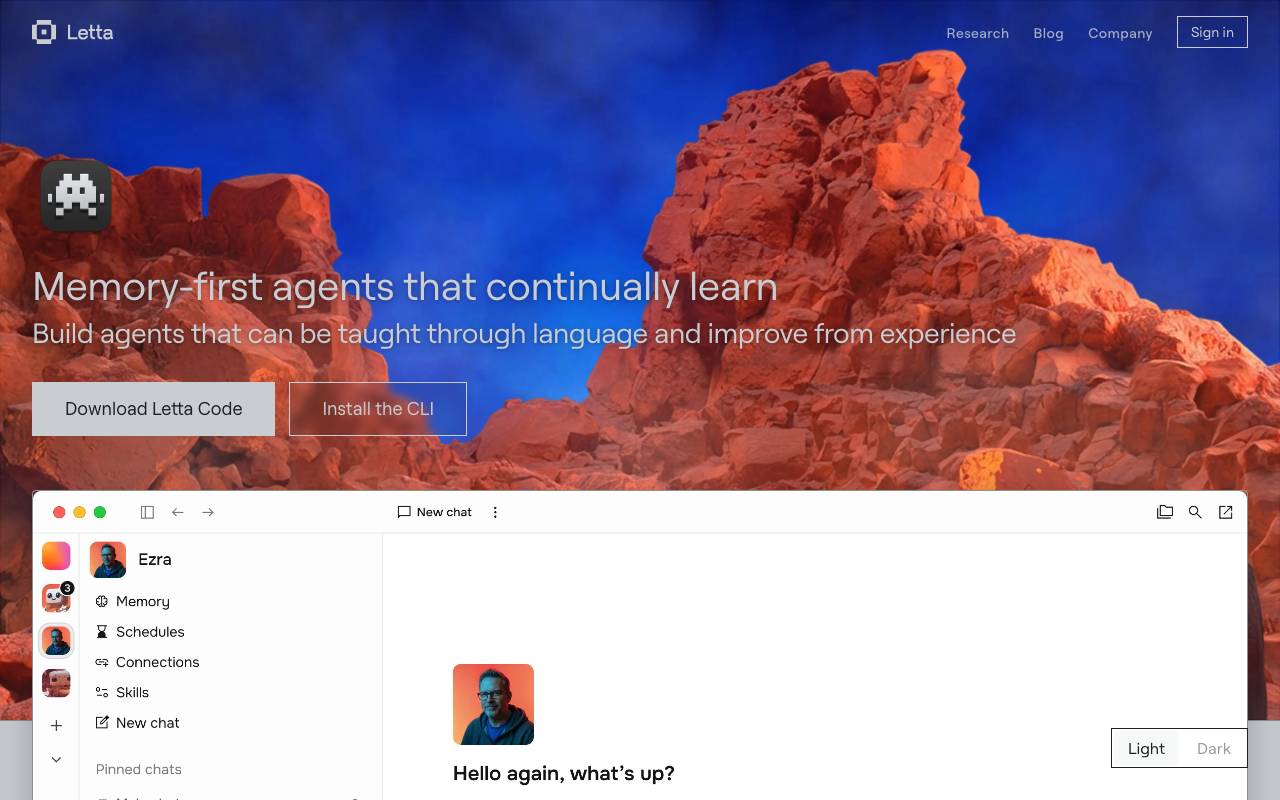
Letta is a developer platform for creating AI agents that retain context across sessions, learn from interactions, and improve their behavior over time. Unlike stateless chatbots, Letta agents maintain persistent memory, allowing them to recall past conversations, user preferences, and accumulated knowledge. The framework provides infrastructure for managing agent memory, reasoning, and tool use, with support for multiple LLM providers. Developers can build, deploy, and observe agents through SDKs and a visual interface, making it suited for applications like personal assistants, customer support, and autonomous workflows that benefit from continuity.
- Stateful agents with persistent memory
- Self-editing memory blocks
- Multi-LLM provider support
- Tool and function calling
- Agent Development Environment (ADE)
- REST API and Python/TypeScript SDKs
AI Drive
Cloud storage with AI capabilities for document analysis, search, and collaboration.
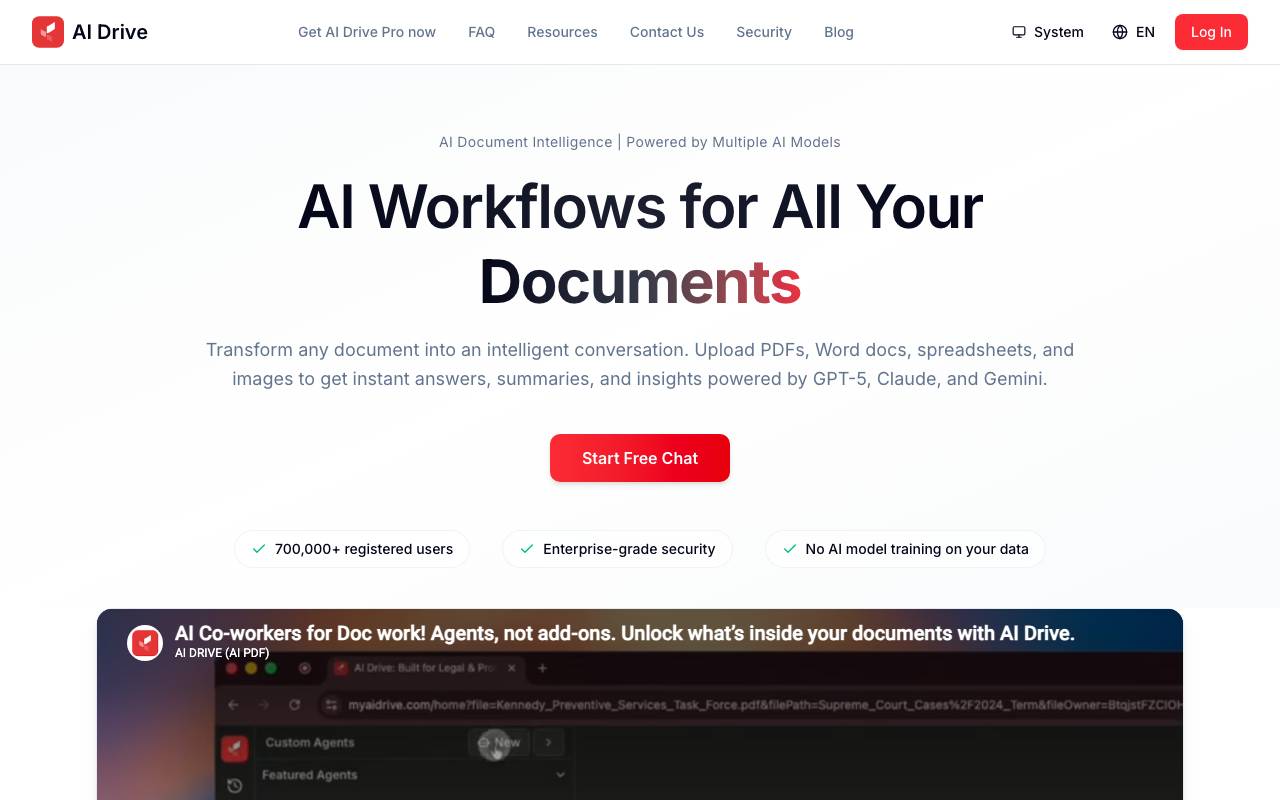
AI Drive is an intelligent document management platform designed to transform static documents into interactive, searchable knowledge bases. It combines cloud storage with advanced artificial intelligence capabilities, enabling users to upload, organize, and interact with their documents using conversational AI. The platform aims to make document analysis, search, and collaboration more intuitive and efficient across various industries. Users can upload diverse file types, including PDFs, Word documents, spreadsheets, and images. The system then allows for instant answers, summaries, and insights, powered by a selection of multiple AI models, including GPT-5, Claude, and Gemini. This multi-model approach is optimized for different tasks, such as analysis, writing, and research, providing flexibility based on the user's specific needs. Key capabilities include Automatic OCR, which converts scanned documents into searchable and editable text with high accuracy, and Smart Metadata Extraction, which automatically identifies critical information like titles, authors, and document types. The platform also offers Multi-Session Chat, allowing users to work with multiple documents simultaneously, and the ability to create Custom AI Agents with tailored prompts and knowledge bases for specialized tasks, such as legal document analysis or financial reporting. For developers, "Live Artifacts" can generate HTML components and code with real-time previews. AI Drive differentiates its custom agents from general AI chat by framing agents as "skilled assistants" capable of extracting data at scale, manipulating PDFs across sets, searching everything at once, and creating deliverables like timelines or comparison reports. This is contrasted with a "regular AI chat" that might provide answers but not execute large-scale data operations. The platform is built with enterprise-grade security, featuring end-to-end encryption (TLS in transit, AES-256 at rest), secure infrastructure in Google US Data Centers, strict access controls, and a commitment to not training AI models on user data. Compliance certifications like ISO 27001 and SOC-2 Type 2 are stated as being in progress.
- AI-powered document chat interface
- Automatic OCR for scanned documents
- Smart metadata extraction
- Multi-session chat for concurrent document work
- Custom AI agents with tailored knowledge bases
- Selection of multiple AI models (GPT-5, Claude, Gemini)
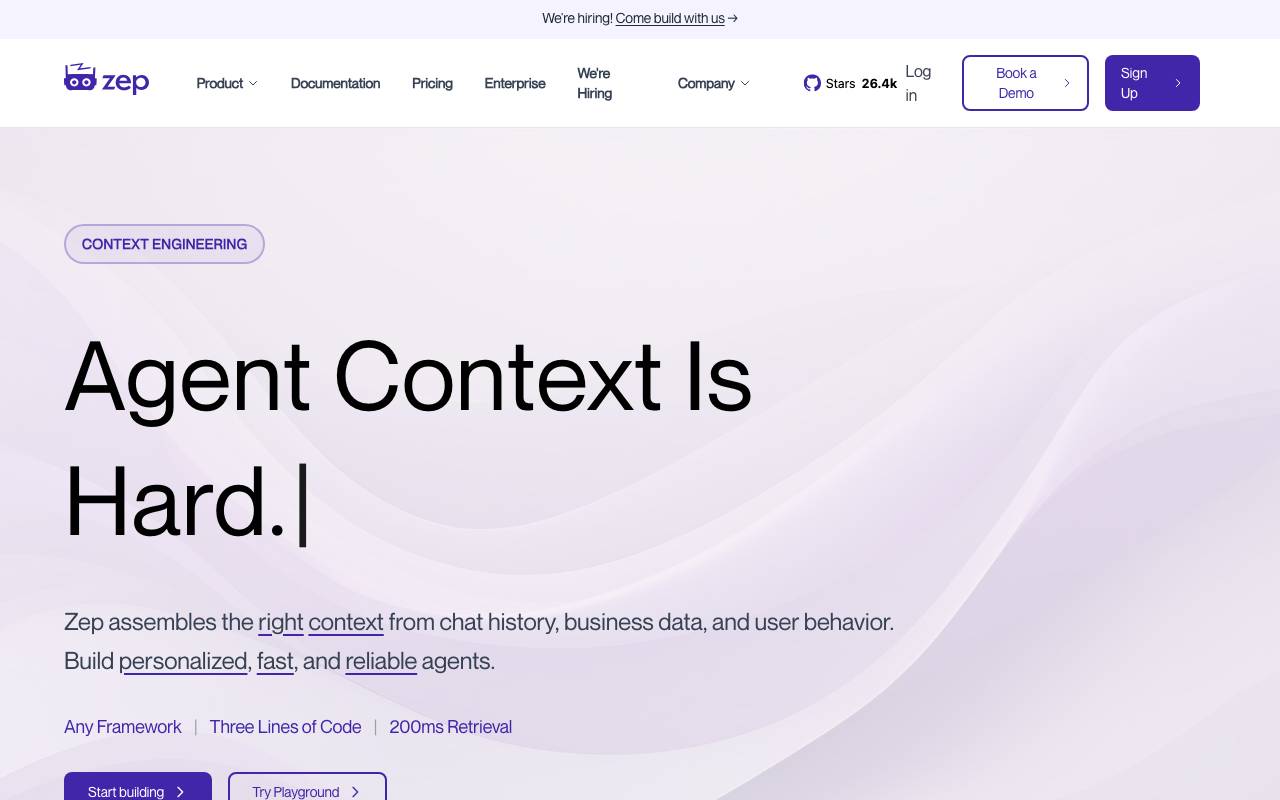
Zep is an enterprise-scale memory platform designed for AI agents, addressing the challenge of maintaining and managing agent memory across numerous users, business data, and past interactions. It aims to provide agents with a continuously learning and evolving understanding of their operational environment, thereby enhancing personalization and accuracy in agent interactions. The core of Zep's architecture is its proprietary Context Graph Engine, which constructs and manages a "Context Lake" of millions of individual context graphs. These graphs are built from diverse sources, including chat history, business data, and user interactions. Zep processes this information to create token-efficient, relevant context for agents through automated context assembly. A key capability is its temporal context graph, which automatically invalidates old facts when new information emerges, ensuring agents always reason with the most current data. Previous states are preserved as history, allowing agents to query what was true at any past date. This system also incorporates "Observations," where Zep analyzes graph structures to surface patterns, recurrences, and co-occurrences in memory, providing agents with a global perspective beyond isolated facts. Zep emphasizes enterprise-grade governance, offering features like attribute-based access control, policy-driven data retention, and full provenance tracking. Every fact within the graph traces back to its original source episode, enabling auditability. The platform is engineered for performance, demonstrating sub-200ms retrieval latency even with graph sizes up to 100 million entities. Designed for seamless integration, Zep can be added to existing agent frameworks or used independently, with SDKs available for Python, TypeScript, and Go. It aims to serve as a foundational layer in the enterprise agent stack, providing a scalable and governed solution for managing complex, evolving agent memory.
- Context Graph Engine
- Context Lake for millions of graphs
- Automated Context Assembly
- Temporal context reasoning
- Provenance tracing for facts
- Observations from memory patterns
Mem0
A persistent memory layer designed to provide long-term, personalized context for large language models and AI agents.
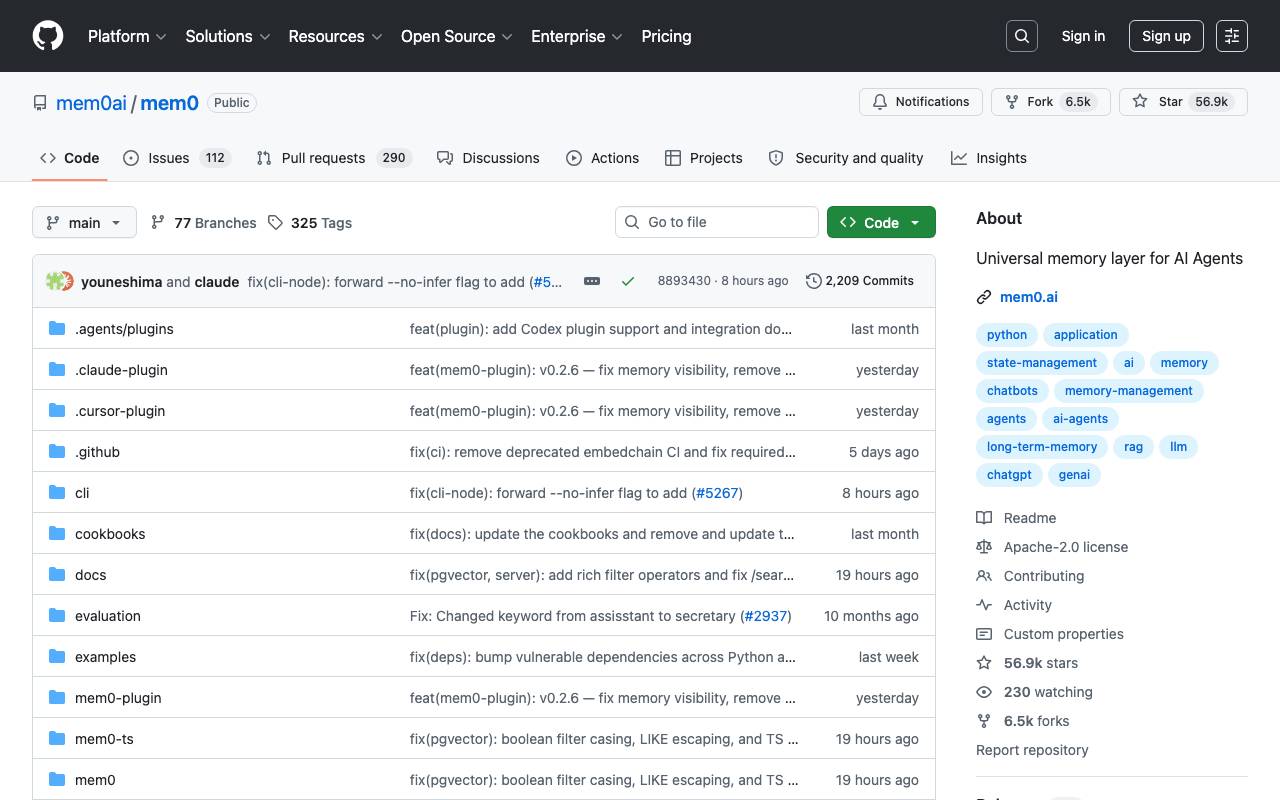
Mem0 is an AI memory layer that integrates with AI assistants and agents to provide personalized and continuous context across interactions. It aims to solve the challenge of maintaining user preferences, adapting to individual needs, and enabling continuous learning for AI systems. The tool utilizes a distinct memory algorithm that focuses on a single-pass, add-only extraction approach, meaning new information is added without overwriting existing memories. Key to its operation are agent-generated facts, which are treated as first-class information. Mem0 also incorporates entity linking, where entities are extracted, embedded, and interconnected across memories to enhance retrieval accuracy. Furthermore, it employs multi-signal retrieval, combining semantic, BM25 keyword, and entity matching to fuse diverse scoring signals, alongside temporal reasoning for time-aware retrieval. Mem0 offers core capabilities such as multi-level memory management, handling User, Session, and Agent states with adaptive personalization. It provides a developer-friendly experience with an intuitive API and cross-platform SDKs for Python and Node.js. Applications include AI assistants requiring consistent, context-rich conversations, customer support chatbots recalling past interactions, healthcare systems tracking patient preferences, and adaptive experiences in productivity tools and gaming. Deployment options are flexible, including a Python/npm library for testing and prototyping, a self-hosted server for teams managing their own infrastructure, and a fully managed cloud platform for zero-operations production use. The platform also reports high benchmark scores on memory evaluation frameworks like LoCoMo, LongMemEval, and BEAM, highlighting its efficiency and recall capabilities.
- Multi-Level Memory (User, Session, Agent state)
- Single-pass, add-only memory extraction
- Entity linking for retrieval boosting
- Multi-signal retrieval (semantic, BM25, entity matching)
- Temporal reasoning for time-aware retrieval
- Developer API, Python SDK, Node.js CLI
Browse all 4 AI Agent Memory tools
The complete, searchable directory — ranked by real user reviews.