Minulý súboj · 2026-07-03 UTC
Code Generation Súboj — 3. júla 2026
Z kategórie Code Generation. 9 body udelených medzi 4 bojovníkov. DeepCoder-14B-Preview získal korunu.
Konečné poradie
Zostava
Bojovníci
Profily každého nástroja, ktorý súťažil v tomto súboji, zoradené podľa ich konečného skóre.
DeepCoder-14B-Preview
Open-source 14B code reasoning model distilled from DeepSeek-R1 and Qwen-14B for advanced code generation.
DeepCoder-14B-Preview is an open-source large language model focused on code generation and programming reasoning. Built on the DeepSeek-R1-Distilled-Qwen-14B base, it inherits chain-of-thought reasoning capabilities while being optimized for software development tasks across multiple programming languages. The model targets developers who need a self-hostable alternative to closed coding assistants. It can handle tasks such as writing functions from natural language prompts, debugging existing code, explaining snippets, and assisting with algorithmic problem solving. Its 14B parameter size offers a balance between capability and the hardware requirements needed to run it locally or on modest cloud GPUs. As a preview release, DeepCoder-14B is best suited for experimentation, research, and integration into developer tooling pipelines rather than mission-critical production deployments without further evaluation.
- Code generation from natural language
- Multi-language programming support
- Chain-of-thought reasoning for debugging
- Distilled from DeepSeek-R1 and Qwen-14B
- Open weights for local deployment
- Suitable for fine-tuning and research

Codename Goose
An open-source, on-machine AI agent automating complex engineering tasks to enhance developer productivity.
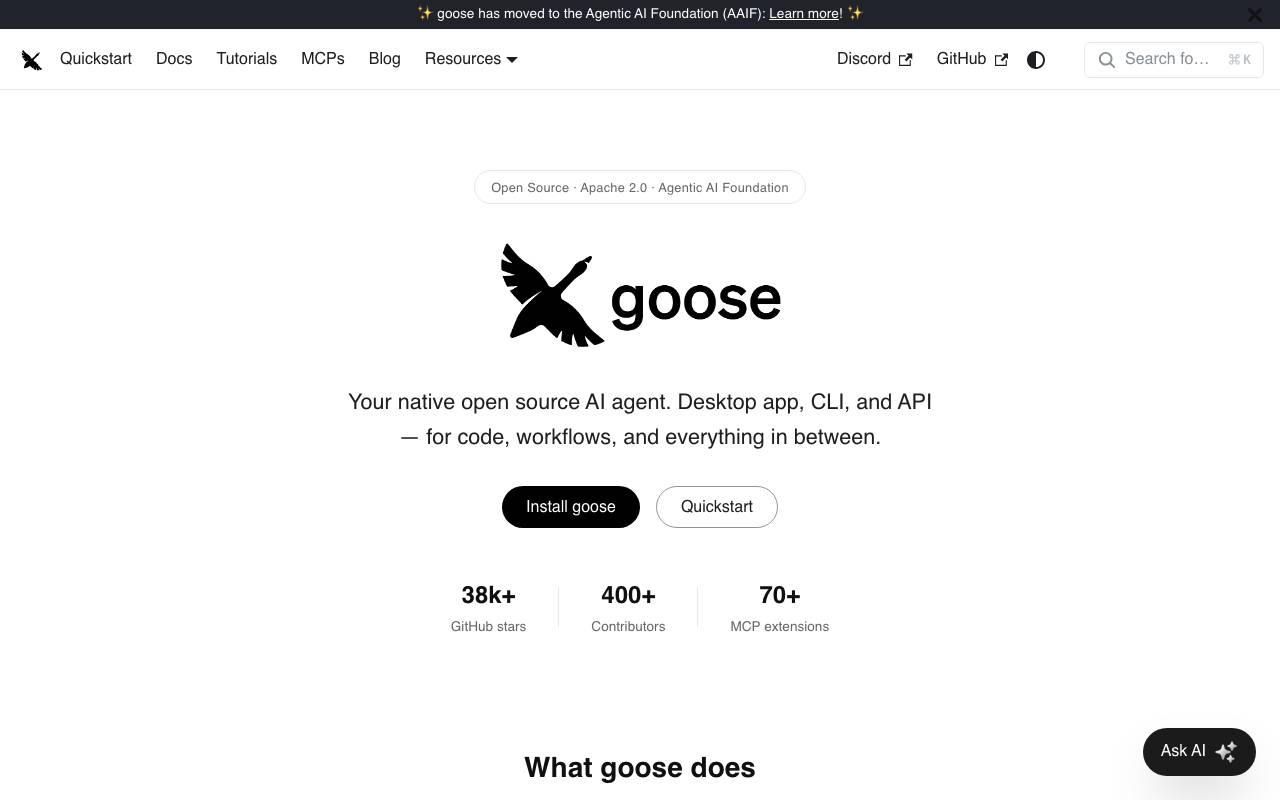
goose is a general-purpose AI agent that runs on your machine, not just for code but for research, writing, automation, data analysis, or anything else you need to get done. It works with 15+ providers, supports API keys, and is extensible via the Model Context Protocol open standard. goose has native desktop apps for macOS, Linux, and Windows, as well as a full CLI and API for embedding.
- Supports 15+ providers
- Embeddable via API
- Connects to 70+ extensions via MCP open standard
- Works with existing subscriptions via ACP
- Customizable via custom distributions and provider configurations

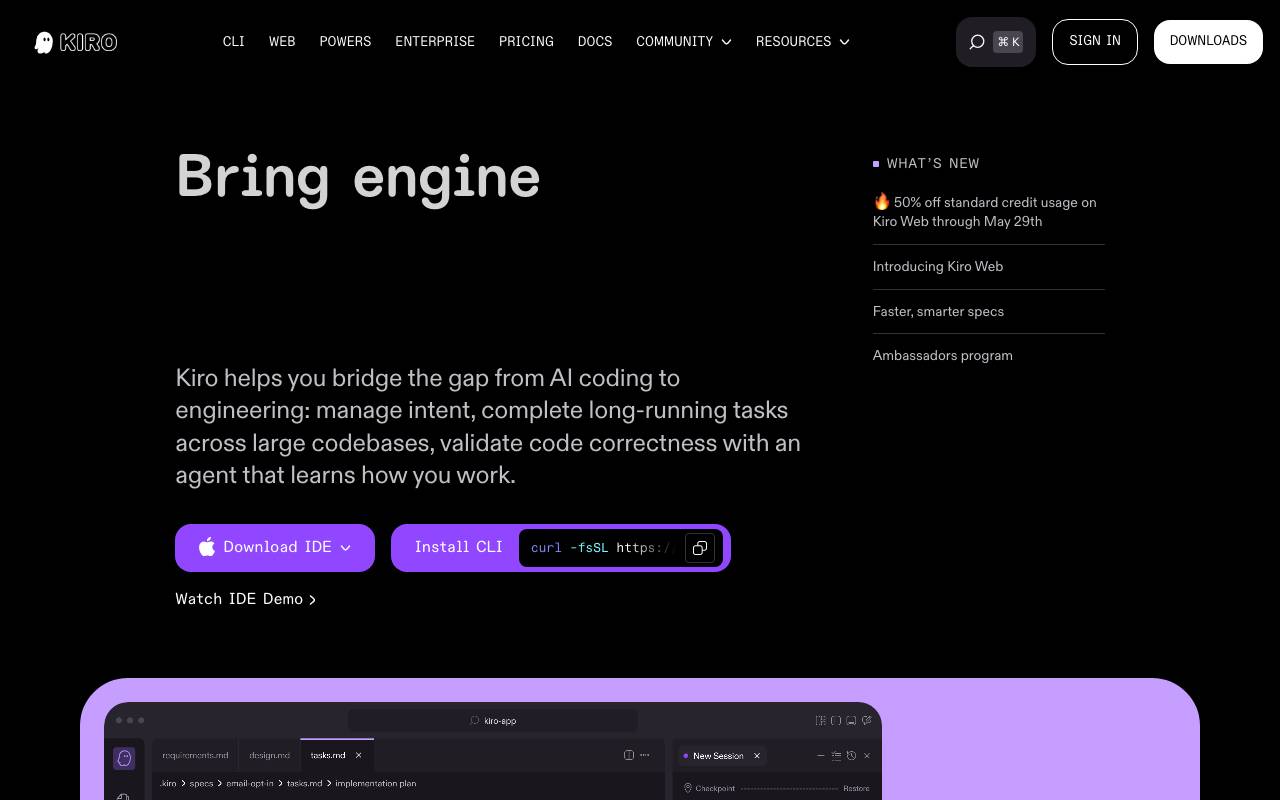
Kiro AI is an AI-powered IDE that enables developers and teams to efficiently turn projects into production-ready code. It achieves this through spec-driven development, which involves turning prompts into structured requirements, architectural designs, and sequenced tasks implemented by parallel agents. Kiro also validates code correctness with property-based tests, reducing issues that pass unit tests but break in production. The platform is designed to bring structure to AI coding, ensuring code is more secure, maintainable, and matches the intended outcome. Kiro supports a range of features, including planning with specs, implementing with parallel agents, catching bugs with property-based tests, and connecting to GitHub or GitLab for review. It allows developers to choose the best model for every task and is powered by popular models such as Anthropic Claude. The platform is built on open standards and is enterprise-ready, offering a credit-based model with no daily or weekly rate limits, IAM and SSO authentication, and administration controls. Kiro has been praised by engineers worldwide for its ability to justify the use of their time for developing business-critical assets in-house, accelerating feature development, and reducing time to customer value. It is a strong ally for startups, naturally turning overlooked docs and specs into robust assets, making growth smoother and future scaling more effective. Overall, Kiro AI is a powerful tool for developers and teams looking to efficiently turn projects into production-ready code, with its focus on spec-driven development, code correctness, and enterprise-readiness making it an attractive option for those seeking to improve their coding workflows.
- AI-assisted code generation
- Contextual code suggestions
- Refactoring and debugging help
- Project scaffolding from prompts
- Integrated development workflow
- Support for multiple languages

SWE-1 ai coding model
Windsurf's in-house AI model family purpose-built for end-to-end software engineering workflows.
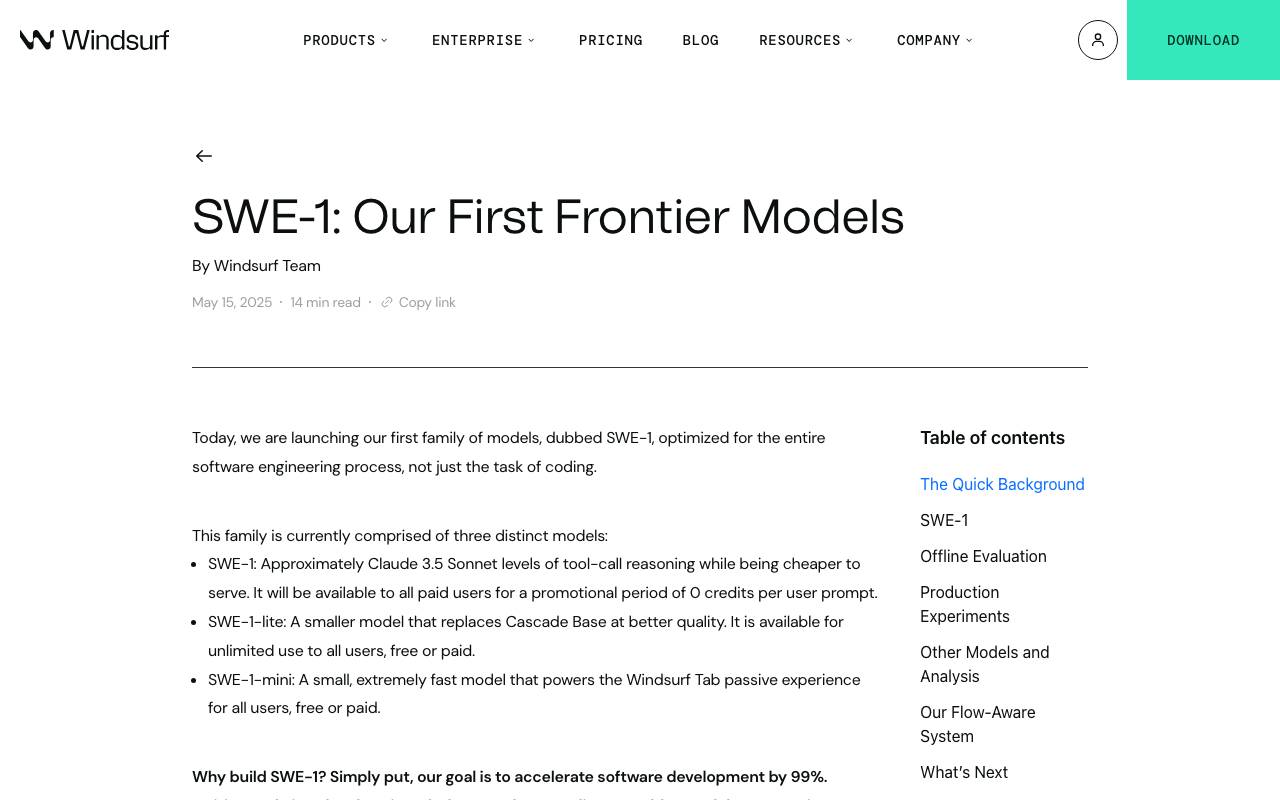
SWE-1 is a family of AI coding models developed by Windsurf to power assistive and agentic software engineering tasks inside its IDE and related products. Rather than focusing solely on code completion, the models are tuned for the broader engineering loop, including reasoning across files, navigating large repositories, and collaborating with human developers over longer sessions. The lineup typically spans different sizes and capability tiers, letting Windsurf route lightweight tasks like autocomplete to faster variants while reserving more capable models for complex edits, refactors, and agent workflows. Because the models are trained with real developer activity in mind, they aim to handle incomplete states, multi-step changes, and tool use more naturally than general-purpose LLMs. SWE-1 is most useful to teams already working inside Windsurf who want a tightly integrated coding model rather than a general chatbot bolted onto an editor.
- Family of models tuned for coding
- Repository-aware reasoning
- Support for agentic, multi-step edits
- Optimized autocomplete and chat modes
- Integration with Windsurf's Cascade workflows
- Routing across lightweight and heavier variants