Best LLM (2026)

이 페이지의 링크를 통해 등록하면 수수료를 받을 수 있지만, 이는 우리의 평가에 영향을 미치지 않습니다.
A curated guide to the best large language models for chat, reasoning, coding, and enterprise use. Compare frontier and open-source LLMs to find the right fit for your workload and budget.
숫자로 보는 LLM
가격 구성
Best LLM (2026)
- 1
 Bifrost1000+ 5.0 (4)
 - 2
 Latest DeepSeek R2Next-generation reasoning-focused AI model from DeepSeek4.8 (6)
 - 3
 DeepSeek V3Open-source mixture-of-experts model offering GPT-4o-level reasoning at a fraction of the cost.4.8 (6)
 - 4
 Simple MP3 to TextAI-powered MP3 to text converter for turning audio into clean, readable transcripts.4.8 (5)
 - 5
 Latest Grok 3 AIConversational AI from xAI built for reasoning, research, and real-time answers.4.8 (5)
 - 6
 Llama 3.3Meta's multilingual open-weight LLM tuned for efficient, high-quality text generation.4.8 (5)
 - 7
 DeepSeek R1An open-source large language model excelling in reasoning, math, and coding tasks with MIT licensing for free use and modification.4.8 (4)
 - 8
 OpenAI o1OpenAI's reasoning-focused model built for complex, multi-step problem solving.4.8 (4)
 - 9
 Janus proDeepSeek's open multimodal model for image generation and visual understanding in one unified architecture.4.8 (4)
 - 10
 PronoiaArabic-first large language model fine-tuned for native-quality understanding and generation.4.7 (6)


Latest DeepSeek R2 is the successor to DeepSeek's R1 reasoning model, designed to deliver stronger step-by-step problem solving across math, coding, and analytical tasks. It aims to extend the open research approach that made earlier DeepSeek releases popular with developers and researchers. The model targets improved accuracy, longer context handling, and more efficient inference compared to its predecessor, making it suitable for technical assistants, agentic workflows, and integration into custom applications. Availability and exact specifications depend on DeepSeek's official release channels. Users can typically access the model via API, chat interface, or by running open weights where provided, allowing flexibility for both individual experimentation and production deployment.
- Advanced chain-of-thought reasoning
- Extended context window
- Code generation and debugging support
- Multilingual understanding
- API and chat-based access
- Suitable for agentic applications

DeepSeek V3
Open-source mixture-of-experts model offering GPT-4o-level reasoning at a fraction of the cost.
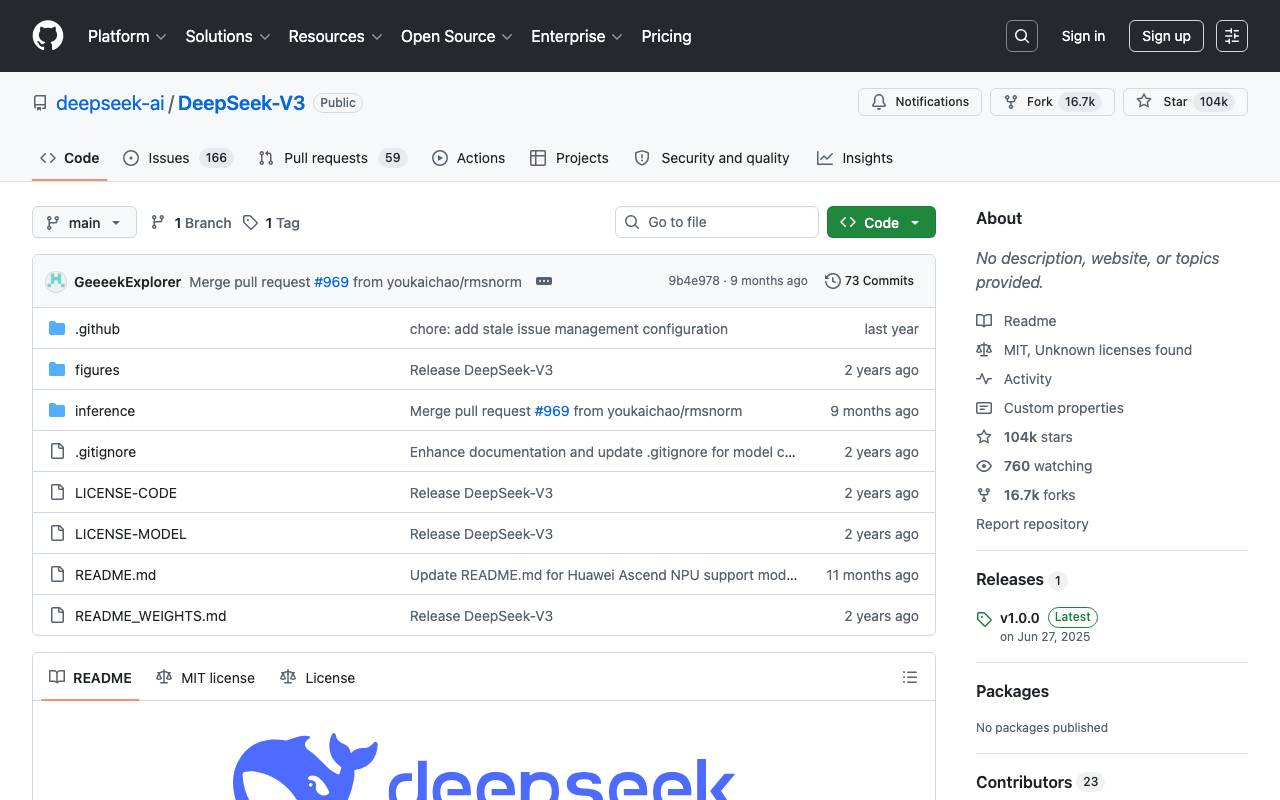
DeepSeek V3 is a large-scale mixture-of-experts (MoE) language model developed by DeepSeek AI. It activates only a subset of its total parameters per token, allowing it to deliver strong performance in reasoning, mathematics, and coding tasks while keeping inference costs significantly lower than comparable dense models. Released with open weights, DeepSeek V3 has become a popular choice for developers and researchers who need a capable foundation model they can self-host, fine-tune, or integrate via API. Benchmarks place it competitively against leading proprietary models like GPT-4o, particularly on math and logical reasoning evaluations. The model is well suited for technical assistants, code generation pipelines, research workflows, and any application where reasoning quality and budget efficiency both matter.
- Mixture-of-experts architecture
- Competitive reasoning and math benchmarks
- Open-source model weights
- API access via DeepSeek platform
- Long context window support
- Fine-tuning friendly

Simple MP3 to Text
AI-powered MP3 to text converter for turning audio into clean, readable transcripts.
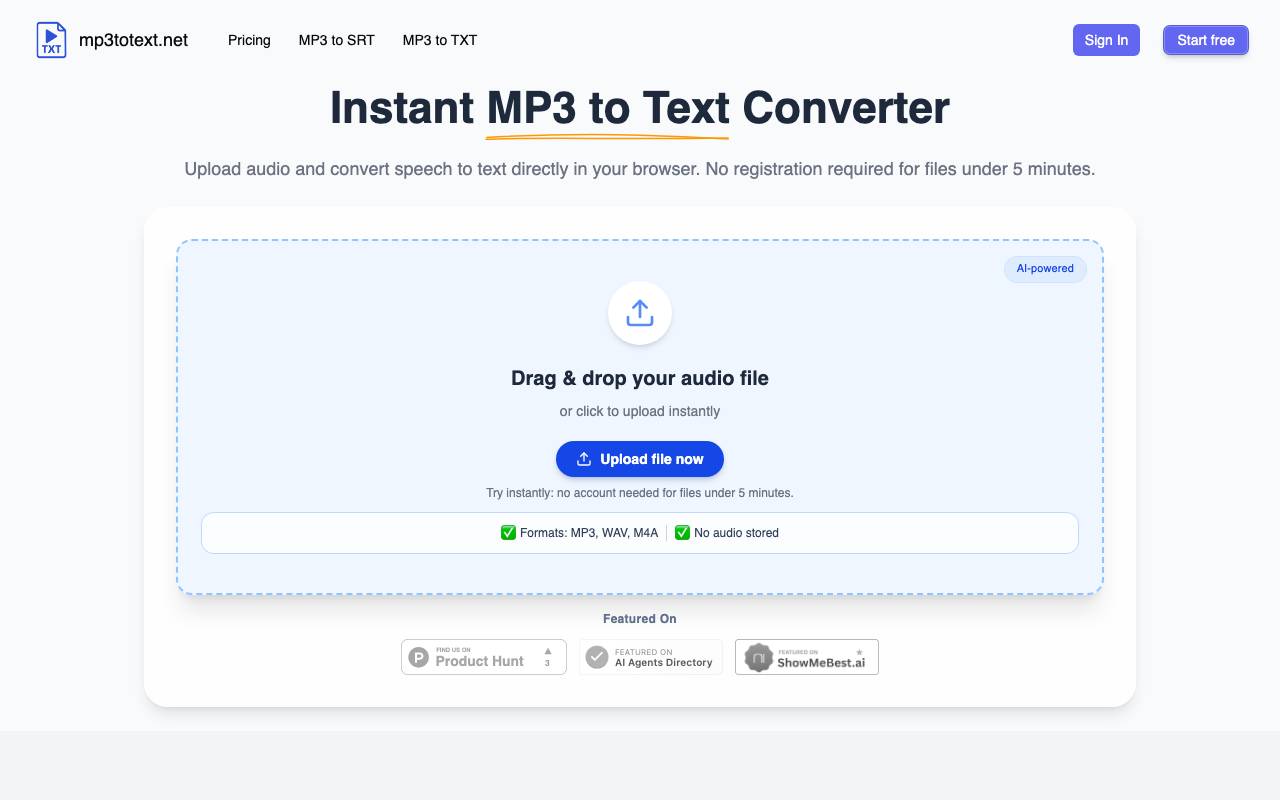
Simple MP3 to Text is a transcription tool that converts audio files such as lectures, podcasts, interviews, and voice notes into written text. It uses AI speech recognition to produce readable transcripts without requiring manual typing or specialized hardware. The service is designed for users who want a quick, low-friction way to extract text from spoken content. Uploaded MP3s are processed automatically, and the resulting text can be copied, edited, or saved for use in notes, articles, study materials, or content repurposing. It suits students, journalists, podcasters, researchers, and anyone who regularly works with recorded audio and prefers a straightforward workflow over more complex transcription platforms.
- MP3 audio to text conversion
- AI-powered speech recognition
- Supports lectures, podcasts, and voice notes
- Clean, copy-ready transcripts
- Browser-based workflow
- Quick turnaround on uploads

Latest Grok 3 AI
Conversational AI from xAI built for reasoning, research, and real-time answers.
The Latest Grok 3 AI is a conversational AI tool developed by xAI designed to facilitate reasoning, research, and real-time answer retrieval. It is likely built to leverage the capabilities of a large language model, allowing users to pose complex inquiries and receive detailed responses. The tool may integrate with various data sources and knowledge graphs to provide accurate and up-to-date information. The Latest Grok 3 AI might be intended for users seeking an advanced research assistant, such as academics, scientists, or professionals looking to stay current in their respective fields. It could enable users to engage in exploratory discussions, receive explanations, or obtain in-depth analysis on a wide range of topics. While specific details about the tool's architecture and features are not available, it is likely to involve a user-facing interface, allowing individuals to interact with the AI model through natural language. The AI might employ natural language processing and generation techniques to comprehend and respond to user input. Given its potential capabilities and features, the Latest Grok 3 AI could stand out as a powerful research tool, but its actual strengths and limitations may depend on its implementation and the specific use cases it is designed to support. Without further information, it is challenging to assess its direct comparisons to other conversational AI tools or the exact scope of its research capabilities. Nonetheless, it has the potential to serve as a valuable resource for those seeking nuanced and in-depth information. It's worth noting that a key strength of the Latest Grok 3 AI could be its ability to handle complex, multi-step reasoning tasks. However, its performance might suffer in areas where data accuracy or up-to-date information is insufficient. In terms of workflow, the Latest Grok 3 AI may be designed to integrate with existing information systems and allow users to leverage external data sources. Its interface could include features for organizing and visualizing the output of its research, making it easier for users to analyze and understand the results.
- Advanced reasoning mode
- Large context window
- Code generation and debugging
- Real-time information lookup
- Multi-turn conversation memory
- Natural language Q&A
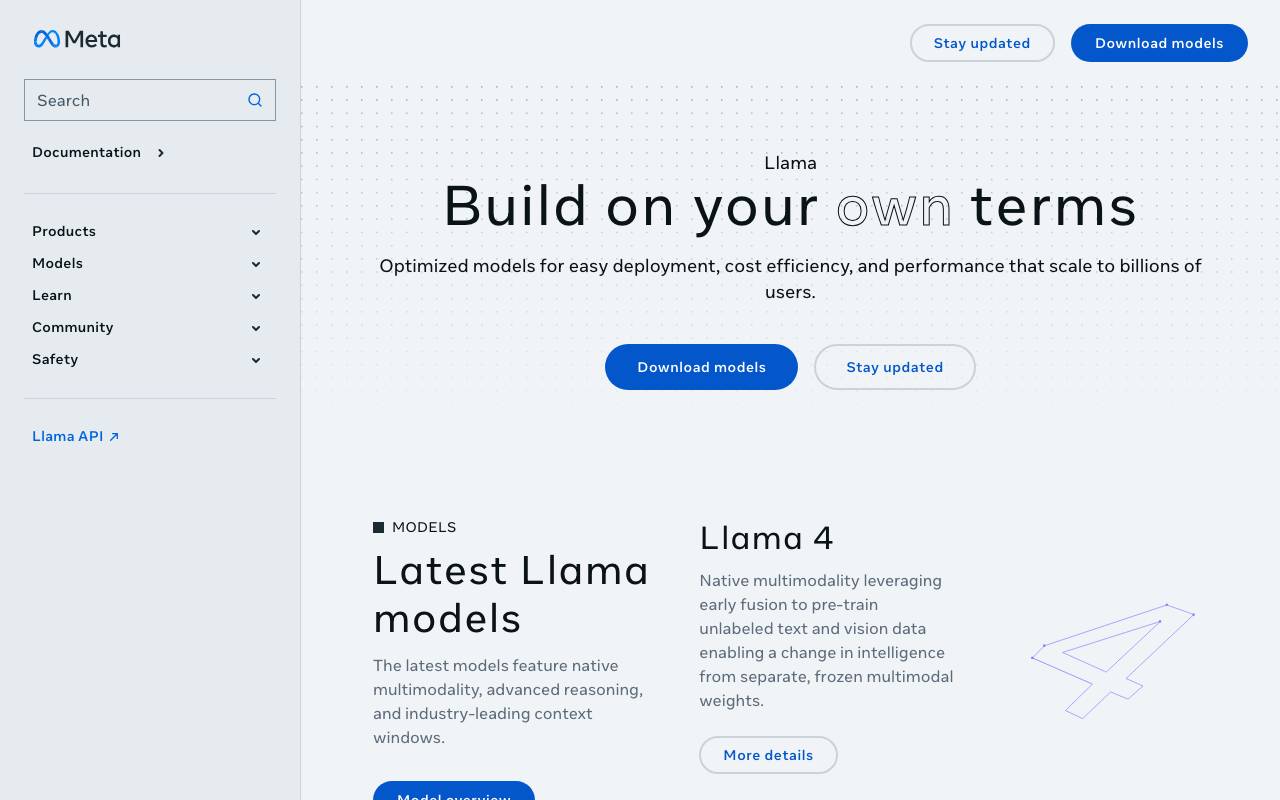
Llama 3.3 is a large language model from Meta designed to deliver strong reasoning, coding, and multilingual capabilities while being more efficient to run than earlier flagship models. It supports a wide range of languages and is suitable for chat assistants, content generation, summarization, and developer tooling. Released with open weights, it can be deployed on-premises or through major cloud and inference providers, giving teams flexibility over cost, latency, and data handling. Its instruction-tuned variant is optimized for following prompts accurately and producing helpful, conversational responses. Developers commonly use Llama 3.3 as a base for fine-tuning domain-specific applications, retrieval-augmented generation systems, and agentic workflows.
- Multilingual text generation
- Instruction-tuned chat variant
- Long-context support
- Coding and reasoning capabilities
- Open weights for fine-tuning
- Compatible with major inference frameworks

DeepSeek R1
An open-source large language model excelling in reasoning, math, and coding tasks with MIT licensing for free use and modification.
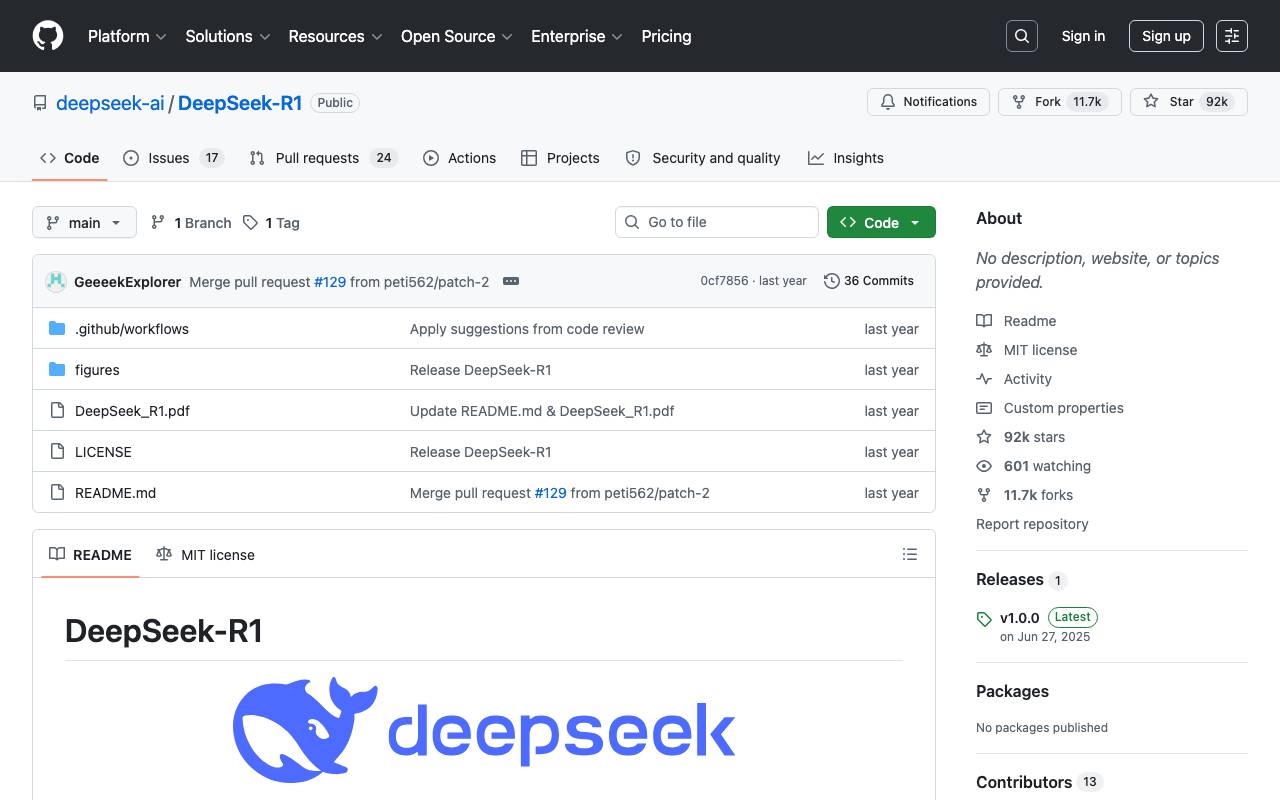
DeepSeek R1 is an open-source large language model that excels in reasoning, math, and coding tasks. It utilizes a Mixture of Experts (MoE) architecture with 37B active parameters and 671B total parameters, supporting 128K context length. The model incorporates advanced reinforcement learning techniques to achieve self-verification, multi-step reflection, and human-aligned reasoning capabilities. DeepSeek R1 has achieved state-of-the-art performance in various benchmarks, including 97.3% accuracy on MATH-500, 79.8% pass rate on AIME 2024, and outperforming 96.3% of Codeforces participants. The model is available in multiple variants, ranging from 1.5B to 70B parameters, and is licensed under MIT for free use and modification. DeepSeek R1 can be used online for free, and a WebGPU-accelerated version can run locally in a browser. The model is designed for complex problem-solving, multilingual understanding, and production-grade code generation. Its strengths include exceptional mathematical reasoning, code generation, and natural language understanding capabilities. However, as an open-source model, it may require technical expertise to deploy and fine-tune for specific use cases. DeepSeek R1 is positioned among the top-performing AI models globally, with capabilities comparable to leading proprietary solutions. Its open-source nature allows for community-driven development and continuous upgrades, including planned multimodal support, conversational enhancement, and distributed inference optimization. The model has a pure reinforcement learning development, which allows it to achieve GPT-4-level math performance at a significantly lower cost. The chain-of-thought visualization capability addresses AI "black box" challenges, providing insights into the model's reasoning process. DeepSeek R1's API offers an OpenAI-compatible endpoint for integration, priced at $0.14 per million tokens. The model's weights are open-source, allowing for commercial use and modification.
- Mixture of Experts (MoE) architecture
- Advanced reinforcement learning techniques
- Self-verification and multi-step reflection capabilities
- Human-aligned reasoning
- Support for 128K context length
- OpenAI-compatible API endpoint


OpenAI o1 is a large language model designed to think through problems step by step before responding. Unlike standard chat models that prioritize quick replies, o1 spends additional compute on internal reasoning, making it better suited for tasks like advanced math, scientific analysis, competitive coding, and intricate logical puzzles. The model is available through ChatGPT and the OpenAI API, where developers and researchers can use it for workflows that demand deeper deliberation. It typically outperforms earlier GPT models on reasoning-heavy benchmarks, though it trades off some response speed and cost in exchange for that depth. O1 is best used as a specialist tool for hard problems rather than a general everyday assistant, complementing faster models in a broader AI stack.
- Chain-of-thought style internal reasoning
- Advanced math and coding problem solving
- API access for developer integration
- Available in ChatGPT for Plus and Pro users
- Improved benchmark scores on STEM tasks
- Suited for complex, multi-step prompts

Janus Pro is an open-source multimodal AI model from DeepSeek, available in 1B and 7B parameter versions. It unifies visual understanding and image generation in a single framework by decoupling the visual encoding pathways, allowing the model to both interpret images and create them from text prompts. The 7B variant delivers competitive results on benchmarks for text-to-image synthesis and visual question answering, often matching or surpassing larger specialized models. Released under an MIT license, Janus Pro can be self-hosted, fine-tuned, and integrated into research or production pipelines without usage restrictions. It suits developers, researchers, and hobbyists who need a flexible multimodal foundation model for experimentation, prototyping, or building applications that combine image creation with image comprehension.
- Text-to-image generation
- Visual question answering and image analysis
- Unified transformer architecture
- 1B and 7B parameter options
- MIT-licensed open weights
- Multimodal input and output support
Pronoia is a large language model specifically fine-tuned for Arabic, aiming to deliver more accurate comprehension, generation, and reasoning in the language than general-purpose multilingual models. It is positioned as a leading Arabic-focused LLM, with optimizations for dialects, classical forms, and modern standard Arabic. The model can be used for tasks such as content creation, summarization, translation, customer support, and conversational AI in Arabic-speaking markets. By concentrating its training on Arabic data, Pronoia targets nuances like morphology, diacritics, and cultural context that broader models often handle inconsistently.
- Arabic-optimized language model
- Text generation and summarization
- Translation support
- Conversational and chatbot capabilities
- Suited for enterprise Arabic NLP
- Coverage of MSA and dialects
모든 23개의 LLM 도구 둘러보기
완전하고 검색 가능한 디렉터리 — 실제 사용자 리뷰로 순위가 매겨졌습니다.


