Best AI Model Serving Platforms (2026)

Ako se prijavite putem veze na ovoj stranici, možemo dobiti naknadu — to ne utječe na naše ocjene.
A curated guide to platforms for deploying, scaling, and managing machine learning models in production, covering hosted inference services, open-source serving frameworks, and GPU-optimized runtimes.
AI Model Serving Platforms u brojkama
Cjenovni miks
Best AI Model Serving Platforms (2026)
- 1
 PineconeFully managed vector database for real-time semantic search in AI applications4.8 (6)
 - 2
 GLM‑4.5Open-source hybrid-reasoning MoE foundation model built for agentic, coding, and tool-use tasks4.5 (6)
 - 3
 AstrolabeSamohostirani, otvoren OpenAI-compatible učitac uputa za OpenClaw agenti s politikom troškova i sigurnosti4.4 (5)
 - 4
 New APIOpen-source LLM gateway unifying multiple AI provider APIs with routing, billing, and analytics4.3 (4)
 - 5
 Jina AIZaklada za pretraživanje multimodalnih, uključujući integraciju modela embedinga, ponovnog redatelja i pipelineova RAG-a.4.2 (5)

Pinecone
Fully managed vector database for real-time semantic search in AI applications
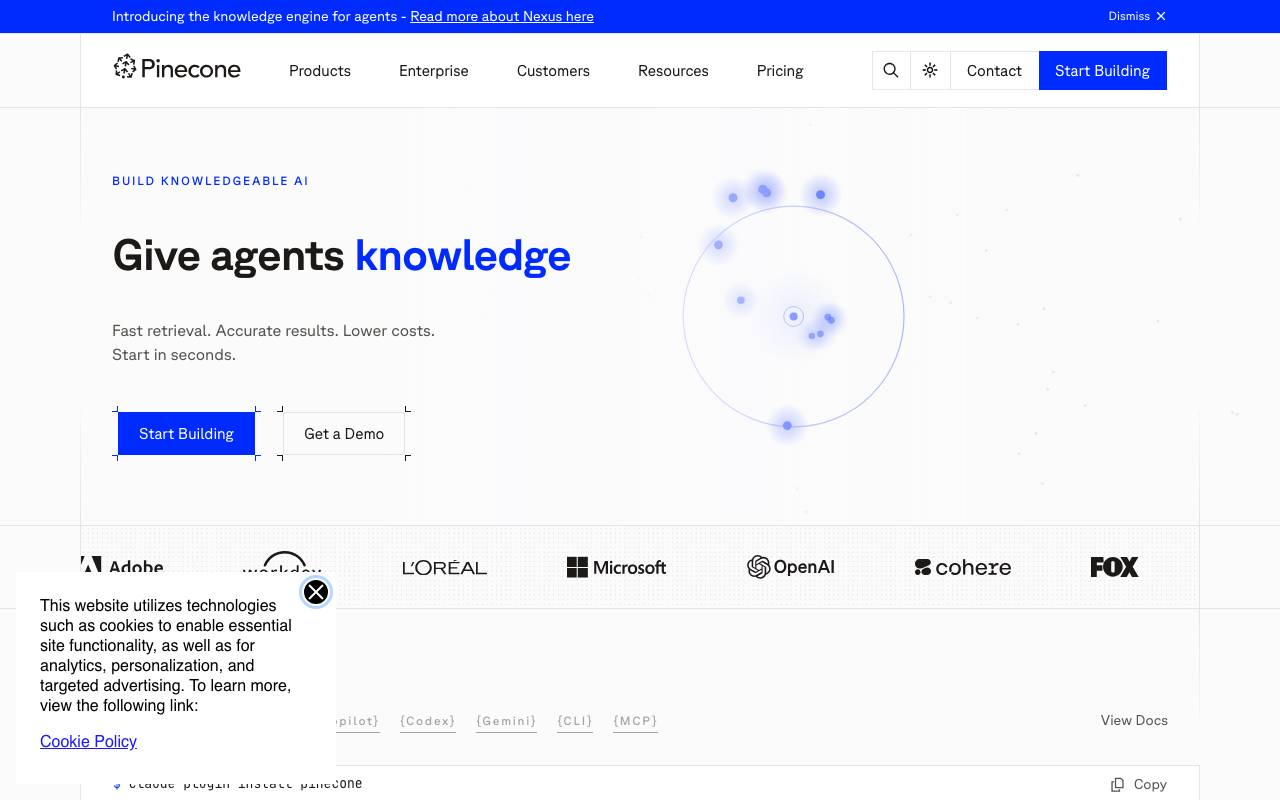
Pinecone is a fully managed vector database designed for AI applications that rely on semantic search and retrieval. It stores high-dimensional vector embeddings and lets developers query them by similarity, returning the most relevant results for tasks like retrieval-augmented generation (RAG), recommendation, and AI agent memory. The service abstracts away the operational complexity of running a vector index at scale. The core problem it addresses is making large volumes of embedding data instantly searchable without requiring teams to manage infrastructure, tune indexing algorithms, or worry about scaling. According to Pinecone, writes are acknowledged in under 100ms and become searchable within seconds, indexing is automatic with algorithms selected per data size, and query latency stays consistent as data grows because all data is searched in parallel. Pinecone is aimed at developers and engineering teams building AI features—from startups prototyping a search feature to enterprises deploying production AI. Users create indexes (organized into namespaces) that hold dense vectors of a chosen dimensionality, then perform upsert, query, fetch, update, and delete operations through APIs or a web console. The platform reports usage in read and write units, reflecting a consumption-based pricing model. Beyond the core database, Pinecone offers components such as Assistant and Inference, along with a management console (app.pinecone.io) for monitoring metrics like read/write units, request latency percentiles, storage size, and record counts. Indexes can be deployed across regions and cloud providers (e.g., AWS us-east-1, us-west-2, eu-west-1). For enterprise customers, Pinecone provides security and compliance features including encryption at rest and in transit, SSO, RBAC, customer-managed encryption keys, and private networking, plus SOC 2 Type II, HIPAA, GDPR, and ISO 27001 certifications, uptime and support SLAs, and dedicated customer success. Pinecone competes with other vector databases and search systems such as Weaviate, Milvus, Qdrant, and pgvector. Its main differentiator is the fully managed, serverless-style approach that removes index tuning and infrastructure management, though this comes at the cost of less control over the underlying engine and potential vendor lock-in compared to self-hosted open-source alternatives.
- Managed dense vector storage and similarity search
- Automatic, continuous indexing and rebalancing
- Namespaces for partitioning data within an index
- Multi-region and multi-cloud index deployment
- Monitoring console with latency, throughput, and storage metrics
- Assistant and Inference components for AI workflows

GLM‑4.5
Open-source hybrid-reasoning MoE foundation model built for agentic, coding, and tool-use tasks
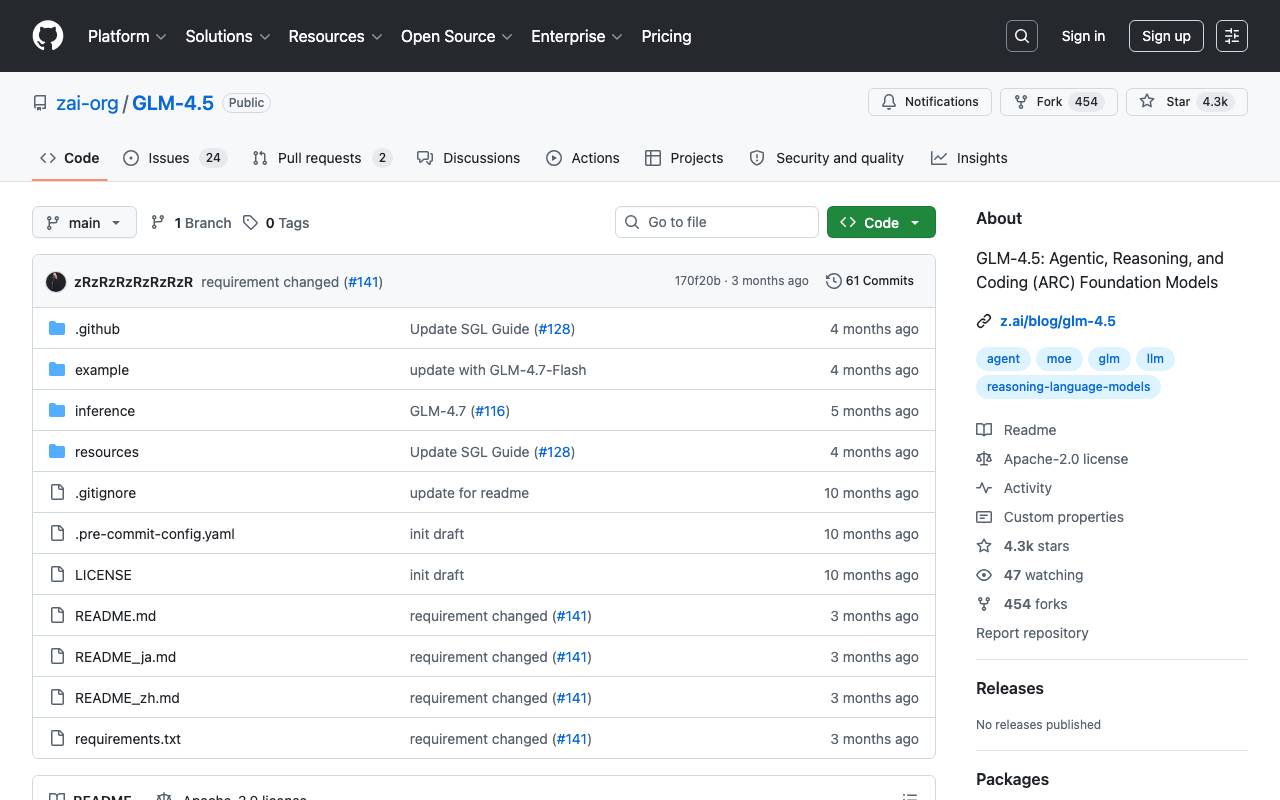
GLM-4.5 is an open-source large language model developed by Zhipu AI (Z.ai) as part of the GLM model family. It uses a Mixture-of-Experts (MoE) architecture and a hybrid-reasoning design that lets the model either "think" before responding or answer directly, targeting agentic workflows, coding, and tool use. The model supports a 128K-token context window and native tool calling. The model is positioned for developers building AI agents and coding assistants. It introduced "Interleaved Thinking," where the model reasons before each response and tool call, which later GLM releases (GLM-4.6 and GLM-4.7) extended with features like Preserved Thinking and Turn-level Thinking. GLM-4.5 emphasizes agentic coding, integrating with mainstream agent frameworks and coding tools such as Claude Code, Cline, Roo Code, and Kilo Code. The GitHub repository hosts model resources, inference code, and examples, while the weights are released openly for self-hosting and the API is offered through the Z.ai API Platform. The repository now also documents successor models GLM-4.6 (expanding context to 200K tokens) and GLM-4.7, alongside a lightweight 30B-A3B variant (GLM-4.7-Flash) for more efficient deployment. As an open-weight release, GLM-4.5 competes with other open models aimed at agentic and coding use cases. Its strengths lie in tool use, reasoning control, and openness, though running a large MoE model locally requires substantial hardware, and newer GLM versions have since superseded it on benchmarks.
- Mixture-of-Experts (MoE) architecture
- Hybrid reasoning with thinking/non-thinking modes
- Native tool calling for agents
- Interleaved thinking before responses and tool calls
- 128K context window
- Agentic coding optimization

Astrolabe
Samohostirani, otvoren OpenAI-compatible učitac uputa za OpenClaw agenti s politikom troškova i sigurnosti
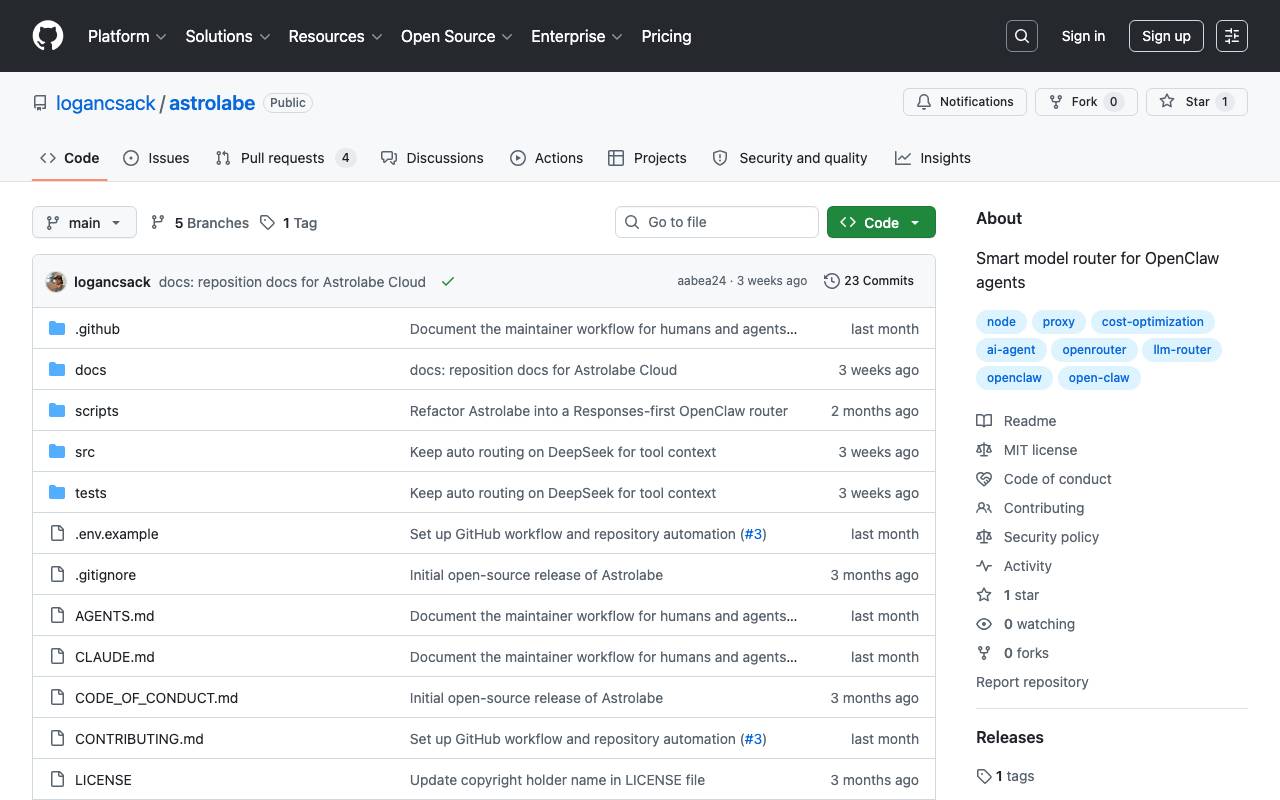
Astrolabe je otvoreni izvor AI brana dizajnirana da sjedni između OpenClaw agenata i OpenRouter-a. On djeluje kao proxy ruta koji klasificira svaki zahtjev, rješava odgovarajući modelni put iz statičke provjere, izvodi poziv protiv OpenRouter-a te primjenjuje sigurnosnu politiku oko korištenja alata i nepovjerljivih ulaznih vrijednosti. Cilj je dati samohostu agenata mogućnost da izbjegnu ruku prije rukovati pružateljima i ID-emajima modela po koraku po korak. Projekt izlaže skup virtualnih modela kao što su astrolabe/auto, astrolabe/pravljenje kod-a, astrolabe/istraživanje, astrolabe/videnje, astrolabe/tiški JSON, astrolabe/cijenovito, i astrolabe/bezbedno. Ovi se mapeju na konkretna podrijetlo odgovarajuće temeljne modele preko pruovađači kao što su DeepSeek, OpenAI, Anthropic, MiniMax, Moonshot, xAI, Qwen, Google i Mistral, koji se vodit u staticne manifeste umjesto kao tvrdogkodiran objekta konfiguracije. Astrolab centrirano obuhvaća četiri brige za agentima otvorenog čvora: fleksibilnost ruta, pouzdanost i ponašanje za slanjem po pitanju, kontrola troškova i strateški plan za sigurnost koristi oruđa. Cilj je bez dodavanja baze podataka, poslužitelja za kontrolu ili bilo kojeg SaaS ovisnosti izvršiti ove načine. Otvoren-source verzija je stanje bez stanja i sama-hostirana; operator osigurava svoj API ključ otvorenog rutera i ključ Astrolab API, zatim pokazuje Otvorenu klavu prema Astrolab instanci. Tijekom izvođenja, OpenClaw pošalje zahtjev na endpoint Astrolabe POST /v1/responses (s POST /v1/chat/completions u obliku prijenosnog adaptora kompatibilnosti). Astrolabe klasificira kategoriju, složenost i modifikatore, riješava jedinicu i skup modela kandidata, pokreće zahtjev, provjerava nenasumične odgovore, primjenjuje politike alata za prijave i možda prebacuje jednom na jači model. On vrati nadogradnji odgovor zajedno s x-astrolabe-* zaglavljem i metapodacima unutrašnjim nizom. Od verzije 0,3,0 Beta, projekt je u ranim fazama razvoja i malen. Namijenjen je izričito okosici OpenClaw sustava umjesto kao univerzalni portal za LLM, pa korisnici koji nisu dio tog protoka rada može naći zrelije alternative u alatima kao što su LiteLLM i svoja ruta u okviru OpenRouter-ove rute. Njegovo stalno, provjereno inventar modela omogućuje reprodukovatnos, ali zahtijeva ručne ažuriranja kad se modeli mijenjaju.
- Podržani v1/responses i v1/chat/completions API endpointi OpenAija
- Statistički provjerene i uključene modeli manifesta preko više pruhađivača
- Virtualne trake modela (auto, koda, istraživanje, vizija, tanja, sigurna, strict-json)
- Klasifikacija zahtjeva po kategoriji, kompleksnosti i modificatorima
- Provjera sigurnosne politique zahtjeva s jednom escalacijom
- Poredjenje odgovora i x-astrolabe-* metapodataka glava

New API
Open-source LLM gateway unifying multiple AI provider APIs with routing, billing, and analytics
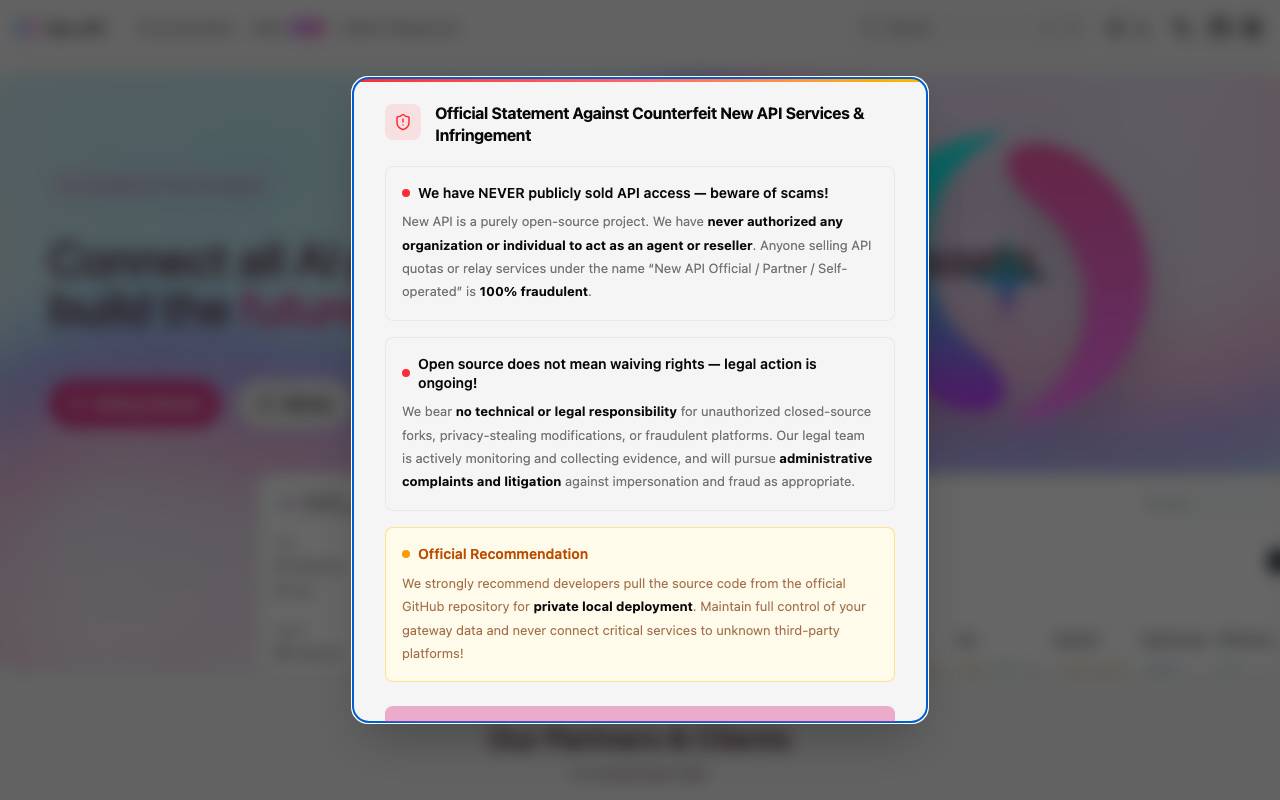
New API is an open-source LLM gateway that provides a unified interface for connecting to multiple AI model providers, including OpenAI, Anthropic Claude, and Google Gemini-style APIs. It acts as a central management layer that lets teams route requests across providers, control access, and track usage from one place. The project is aimed at developers, platform teams, and organizations that consume AI APIs at scale and want a single gateway rather than integrating each provider separately. By exposing OpenAI-compatible endpoints, it allows existing applications and SDKs to work with many backends without rewriting client code. Beyond basic proxying, New API focuses on operational concerns such as token-based quotas, billing and credit management, request auditing, and usage analytics. These features make it suitable for building internal AI platforms or reselling/metering access to multiple users or teams. As an open-source, self-hostable tool, it gives operators control over deployment and data flow, which can be important for cost management and compliance. It positions itself in the same space as other API gateways and aggregators like LiteLLM and One API, from which it derives. As with most self-hosted gateways, adopting New API requires infrastructure setup and ongoing maintenance, and the breadth of provider support and stability depend on community contributions.
- Unified multi-provider API gateway
- OpenAI-compatible endpoints
- Request routing across model providers
- Token quotas and billing management
- Usage analytics and auditing

Jina AI
Zaklada za pretraživanje multimodalnih, uključujući integraciju modela embedinga, ponovnog redatelja i pipelineova RAG-a.

Jina AI pruža niz temeljnih modela i API-ji zasnovani na pretrazi, vračanju rezultata i višeznačnoj razumijevanju. Njezini su osnovne ponude tekstualne i slikovne uvrstitve, neuronsko vračanje rezultata, zero-shot razreditelj i alate za gradnju tehnologija vračanja rezultata koji uključuju generaciju na veliku skalu. Platforma je dizajnirana za razvojače i timove koji graditelj pretraživaca, sustava preporuka i asistenata koji trebaju razmatrati tekst, slike i strukturirane podatke. Modeli su dostupni kroz domaćin API-e i otvoreno kôdsko osvježavanje, s podrškom više jezika i duge kontekste za obradu velikih dokumenta. Jina AI integrira se s učestalim vektorskim bazoima i okvirima sustava za učenje veza (LLM), tako da postaje praktičan građevni kamen za proizvodne grade semantički pretraživački sustave i sustave za dostup informacija.
- Modeli embedinga za tekst i slike
- API-ji Neural Reranker
- Zero-šampion klasifikacija
- Podrška dugih dokumenta
- Multilingvovalno pretraživanje
- Integracije RAG i baza podataka vektora
Pregledaj svih 5 AI Model Serving Platforms alata
Potpuni, pretraživi direktorij — rangiran prema stvarnim recenzijama korisnika.


