Best Coding Library (2026)

If you sign up through a link on this page, we may earn a commission — it never affects our rankings.
A curated guide to the best Coding Library tools, covering reusable code collections, SDKs, and packages that help developers ship faster with proven components.
Coding Library by the numbers
Pricing mix
Best Coding Library (2026)
- 1
 assistant-uiAn open-source TypeScript/React library enabling developers to integrate AI chat interfaces into their applications.4.8 (5)
 - 2
 PydanticPython data validation and settings management powered by type hints.4.8 (4)
 - 3
 OutlinesPython library for structured, reliable outputs from large language models.4.6 (5)
 - 4
 PixeeAIAn automated product security engineer that fixes vulnerabilities, hardens code, and squashes bugs to enhance software security.4.5 (4)

assistant-ui
An open-source TypeScript/React library enabling developers to integrate AI chat interfaces into their applications.
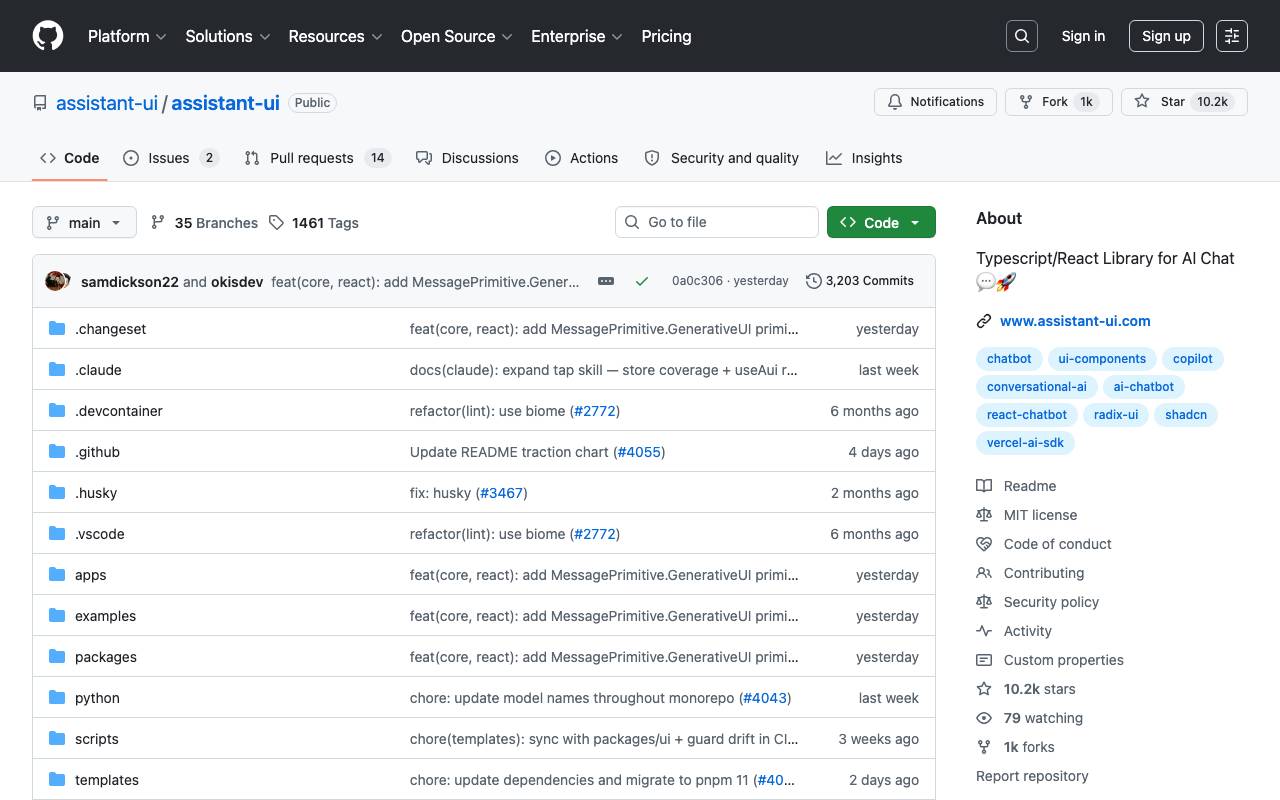
assistant-ui is a Coding Library tool listed on Agent Pantheon.

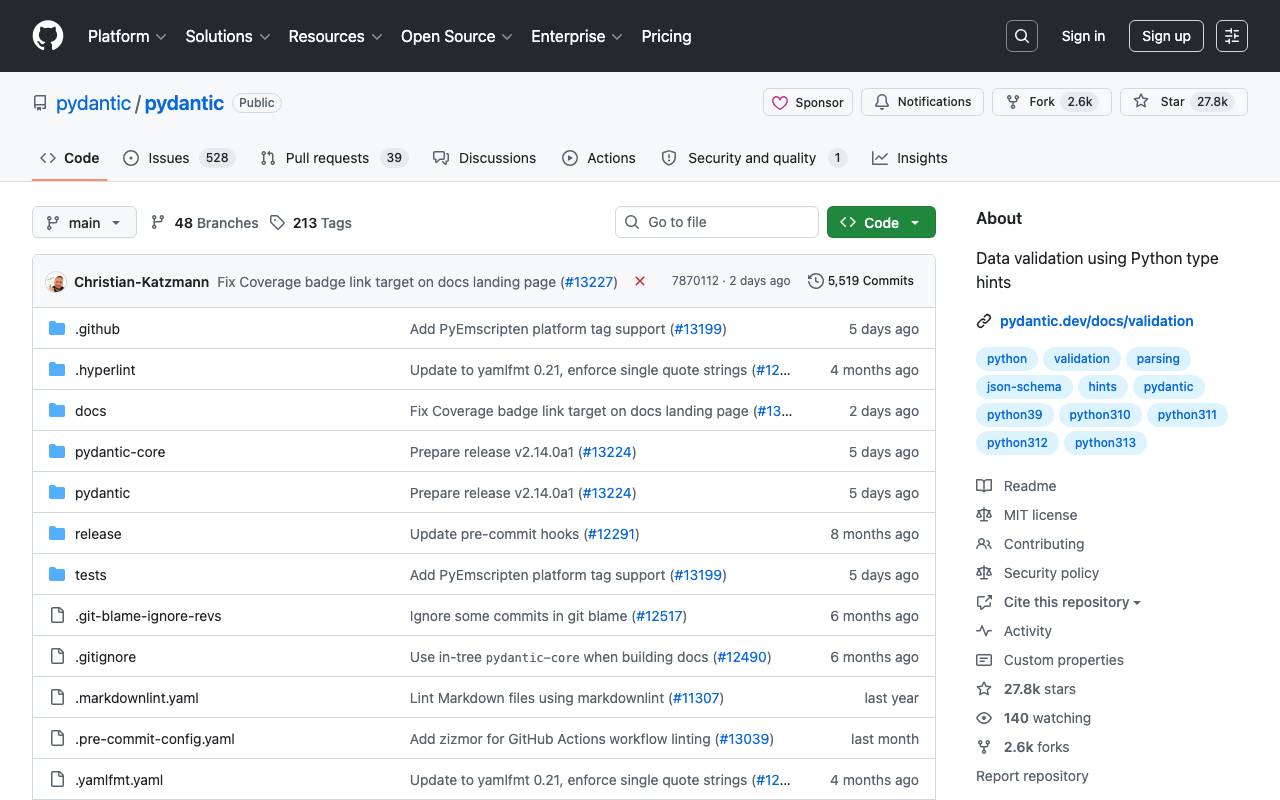
Pydantic is an open-source Python library that uses standard type hints to validate, parse, and serialize data at runtime. It converts incoming data into well-typed Python objects, raising clear, structured errors when inputs don't match the expected schema. Widely adopted across the Python ecosystem, Pydantic underpins frameworks like FastAPI and is commonly used for API payloads, configuration management, and structured outputs from LLMs. Version 2 introduced a Rust-based core that delivers significantly faster validation while preserving the familiar, Pythonic API. Beyond basic validation, Pydantic supports JSON schema generation, custom validators, strict and lax type coercion, and environment-based settings via the pydantic-settings package, making it a practical foundation for production Python applications.
- Type-hint based data validation and parsing
- Automatic JSON schema generation
- Custom validators and serializers
- Settings management via pydantic-settings
- Strict and coercive validation modes
- Integration with LLM structured output workflows

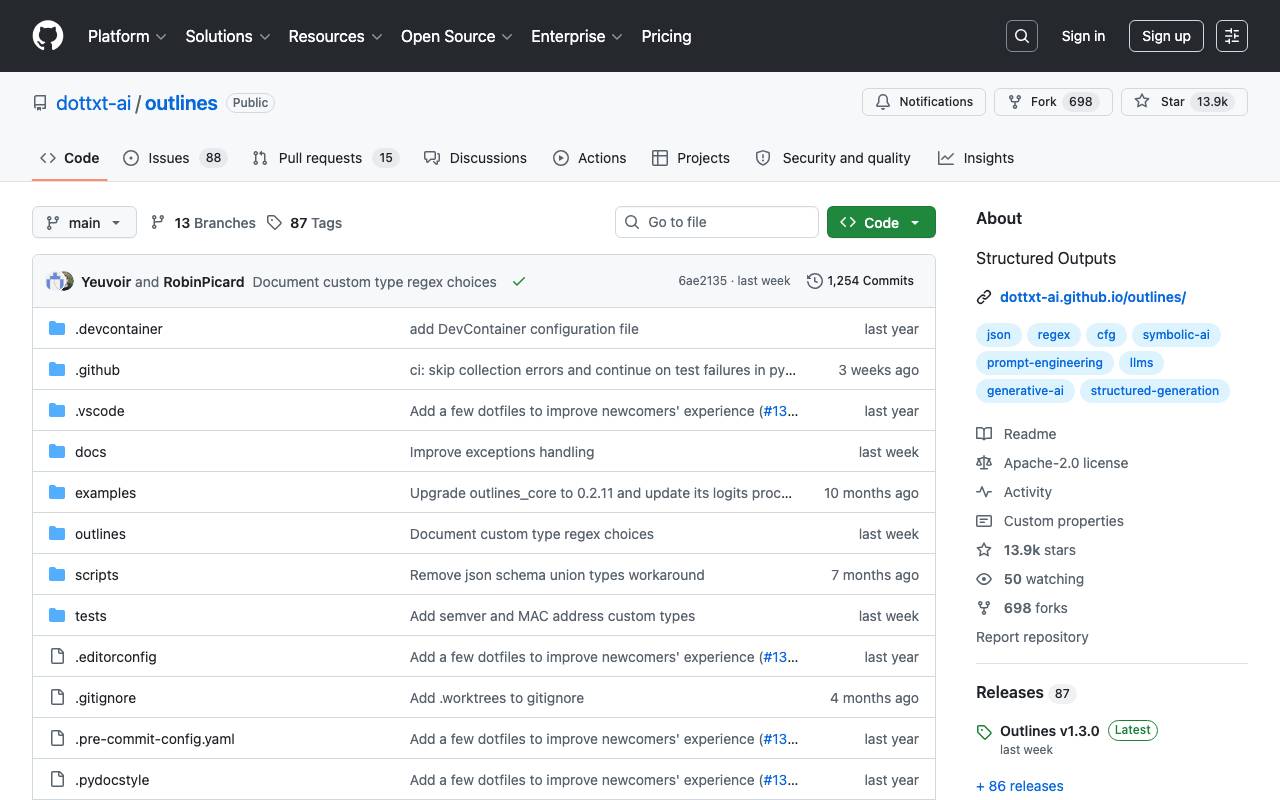
Outlines is an open-source Python library designed to help developers generate structured, predictable text from large language models. Instead of relying on free-form prompts and hoping the model returns valid output, Outlines lets you constrain generation to specific formats such as JSON schemas, regular expressions, type signatures, or context-free grammars. The library integrates with popular model backends and is particularly useful for building production pipelines where parsing, validation, and reliability matter. Common use cases include extracting structured data, routing decisions, function calling, and agent workflows that depend on machine-readable responses. Because Outlines guides the model during decoding rather than after the fact, it can reduce retries, post-processing, and brittle prompt engineering, making LLM-driven applications easier to maintain.
- Schema-constrained JSON generation
- Regex and grammar-guided decoding
- Type-based structured outputs
- Support for multiple LLM backends
- Tooling for prompt templating
- Open-source Python API

PixeeAI
An automated product security engineer that fixes vulnerabilities, hardens code, and squashes bugs to enhance software security.

PixeeAI is an automated product security engineer that helps enterprises strengthen software security by identifying and fixing vulnerabilities, eliminating false positives, and preventing future threats. It works by analyzing codebases, security policies, and architecture to determine the real attack surface, then generating fixes that are ready to merge and respect existing security rules and CI. By using PixeeAI, companies can clear backlogs, reduce noise, and enhance their overall security posture. PixeeAI's capabilities include deep codebase analysis, exploitability analysis, false positive elimination, threat modeling, and generation of fixes that are tailored to the specific needs of the development team. It can identify real risks, prioritize remediation, and provide evidence-based triage to ensure that only critical issues are addressed. PixeeAI also allows developers to work with the AI-generated fixes, respecting their conventions and security rules, and enabling them to prioritize and focus on the most critical security weaknesses. By automating the process of identifying and fixing vulnerabilities, PixeeAI can significantly reduce the complexity and time required to resolve security backlogs, enabling development teams to focus on shipping new features and delivering value to customers.
- Deep codebase analysis
- Exploitability analysis
- False positive elimination
- Threat modeling
- Convention-aware fixes
- Ready-to-merge PRs
Browse all 4 Coding Library tools
The complete, searchable directory — ranked by real user reviews.


