Minulá bitva · 2026-07-07 UTC
AI Agents Frameworks Souboj — 7. července 2026
Z kategorie AI Agents Frameworks. 25 hlasů umístěno napříč 10 bojovníky. Airtop API získal korunu.
Konečné pořadí
Sestava
Bojovníci
Profily každého nástroje, který soutěžil v této bitvě, seřazené podle jejich konečného skóre.

Airtop API
Cloud browser automation API built for AI agents to navigate, extract, and act on the web.
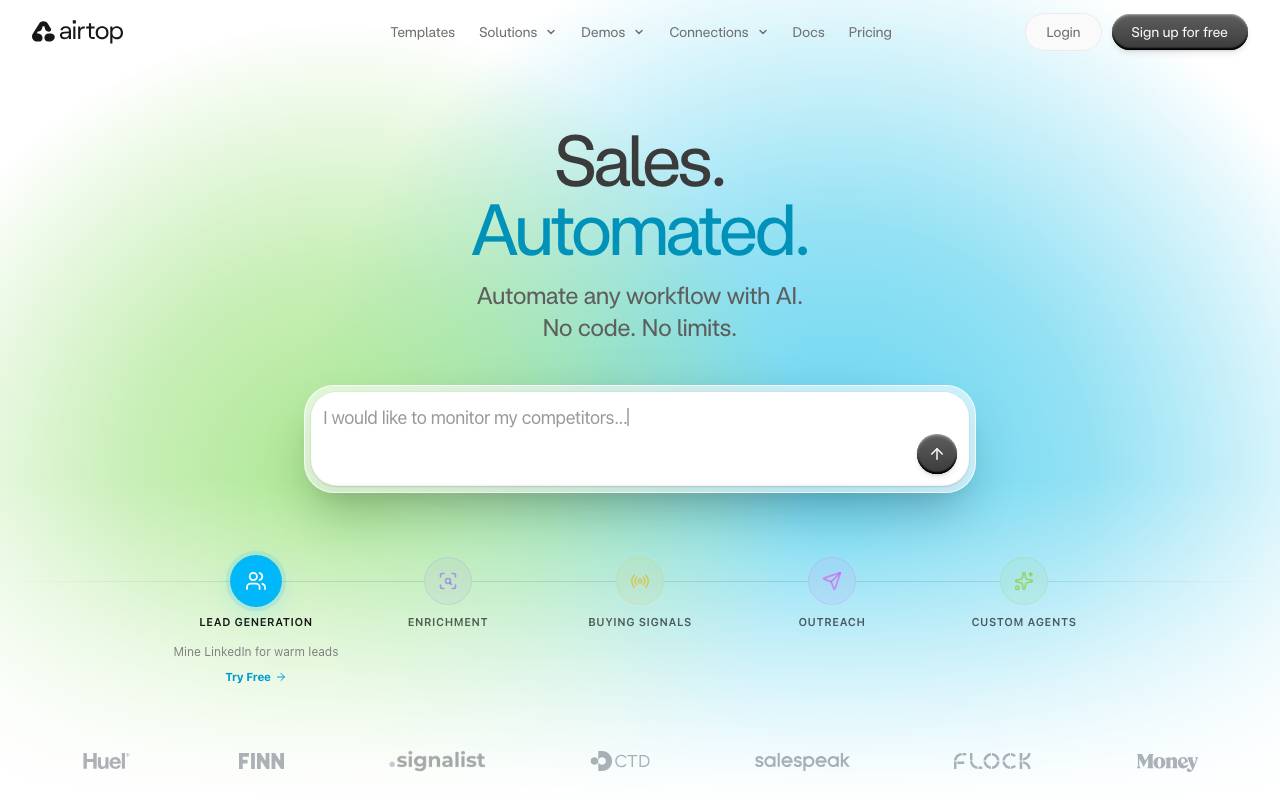
Airtop API provides a managed cloud browser environment that AI agents can drive through natural language instructions instead of brittle selectors. Developers send high-level commands and Airtop handles page navigation, authentication state, data extraction, and interaction across modern web apps. The service is aimed at teams building autonomous agents, research assistants, and workflow automations that need to interact with sites lacking public APIs. By abstracting away CAPTCHAs, sessions, and DOM parsing, it lets engineers focus on agent logic rather than infrastructure. Airtop integrates with common agent frameworks and supports persistent sessions, making it suitable for repeated tasks across logged-in accounts and multi-step browsing flows.
- Cloud-hosted browser sessions
- Natural language page interaction and extraction
- Persistent authenticated sessions
- CAPTCHA and anti-bot handling
- SDKs and agent framework integrations
- Structured data output for downstream LLMs

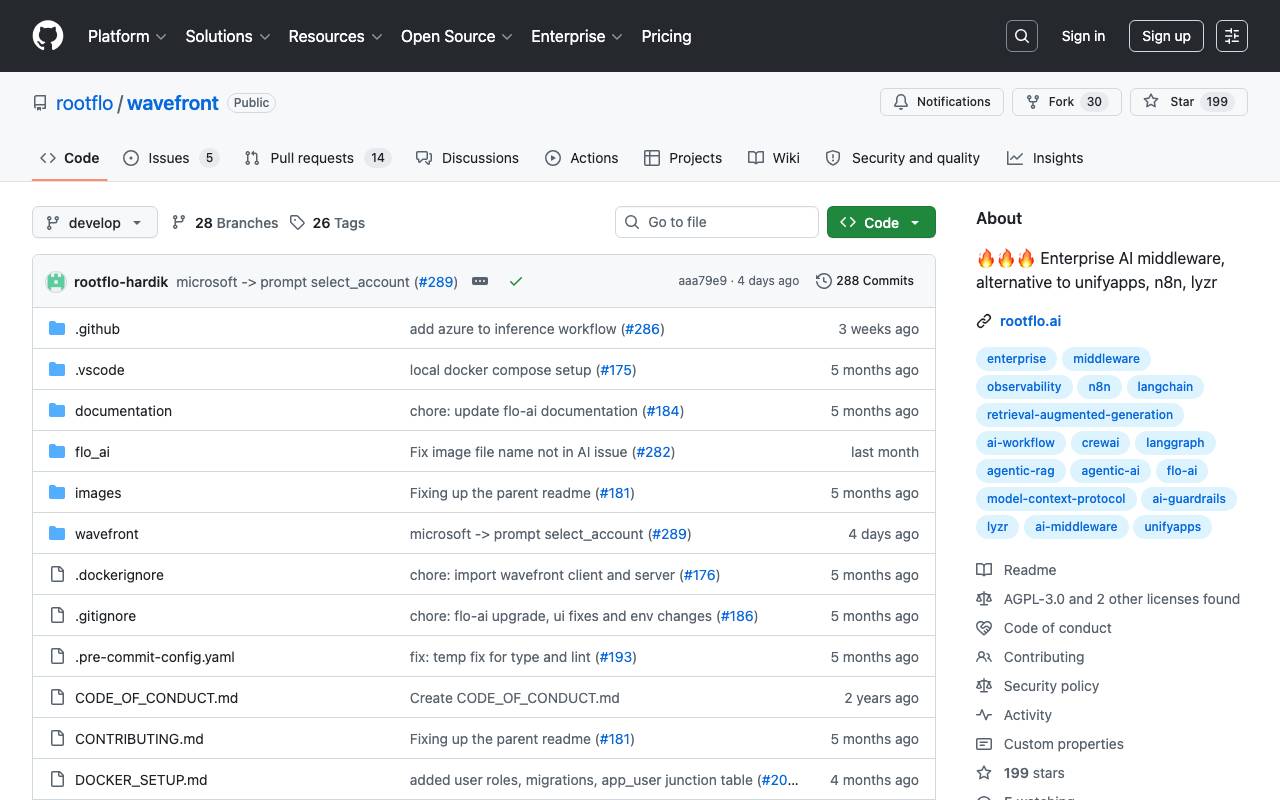
FloAI is an open-source Python framework designed to streamline the development of AI agents and multi-step workflows. It provides a modular foundation where developers can compose agents, tools, and tasks into structured pipelines that tackle complex problems. The framework emphasizes composability, letting teams mix and match agent roles, language models, and custom tools without rewriting orchestration logic. This makes it well-suited for prototyping autonomous systems, research projects, and production-grade agent applications. Because it is open source and Python-native, FloAI integrates easily with the broader ML ecosystem and can be extended or self-hosted to match specific project requirements.
- Composable agent building blocks
- Workflow orchestration for complex tasks
- Support for multiple LLM providers
- Custom tool and function integration
- Multi-agent collaboration patterns
- Extensible open-source codebase

Mini LLM Flow
Minimalist 100-line LLM framework for building self-programming agent workflows
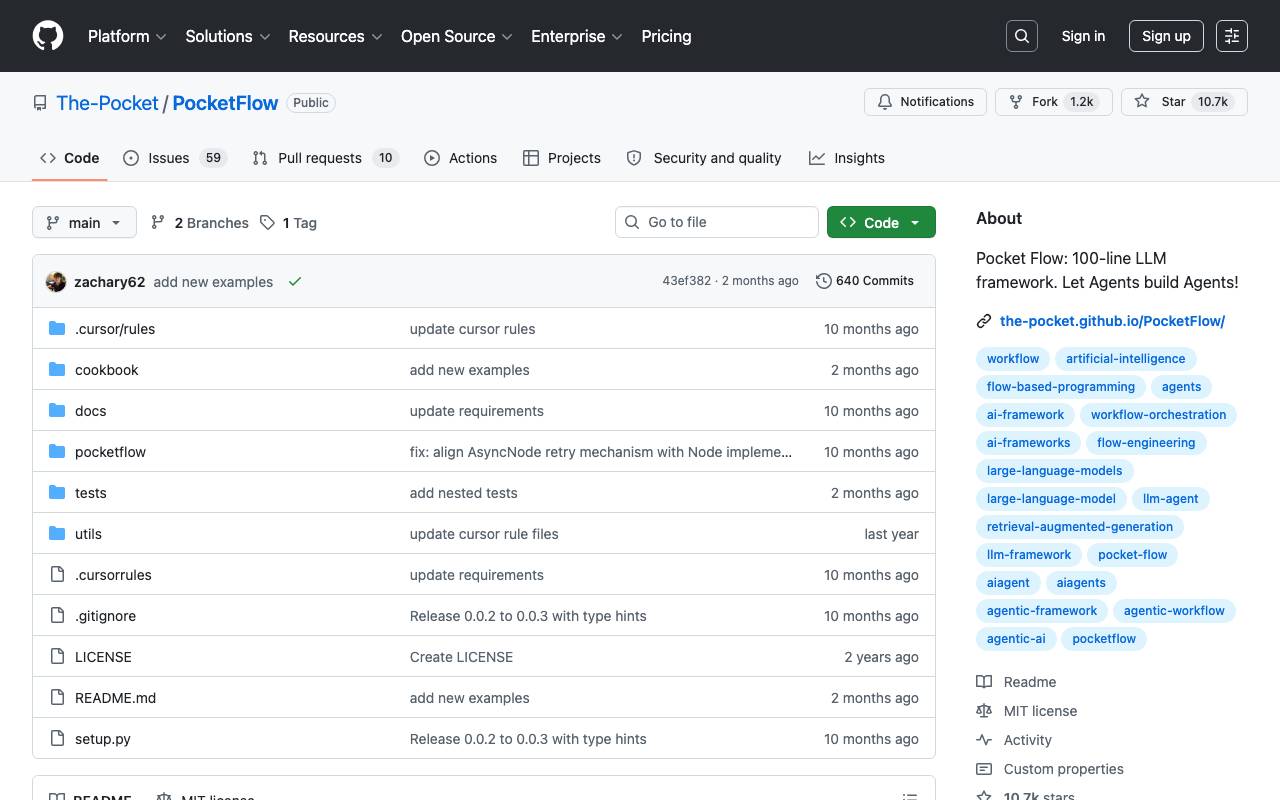
Mini LLM Flow is a lightweight open-source framework that distills LLM orchestration down to roughly 100 lines of code. It provides the essential building blocks for chaining prompts, managing state, and constructing agent workflows without the overhead of larger frameworks. The project's core idea is that a minimal abstraction is easier for LLMs themselves to understand, extend, and generate code against. This makes it well-suited for experiments in self-programming agents, where models reason about and modify their own workflow logic. Developers can use it as a learning tool, a foundation for custom agent systems, or a stripped-down alternative to heavier orchestration libraries.
- Around 100 lines of core code
- Prompt chaining and flow control
- Support for agent-style workflows
- Designed for LLM self-programming
- Minimal dependencies
- Open and easily forkable

NOVA is an autonomous AI agent designed for launching meme tokens and tracking markets on the Solana blockchain. It appears to be an open-source project, as evidenced by its presence on GitHub. The tool likely automates tasks related to meme token launches and market monitoring, potentially providing insights or streamlining processes for users. However, specific details about its functionality, target audience, and capabilities are limited. NOVA seems to cater to users interested in Solana-based meme tokens, possibly including traders, creators, or enthusiasts. Without further information, its exact workflow, integrations, and performance remain unclear.
- Autonomous AI agent workflow
- Meme token launch automation on Solana
- Real-time market intelligence
- On-chain activity monitoring
- Trend and signal tracking
- Designed for traders and creators
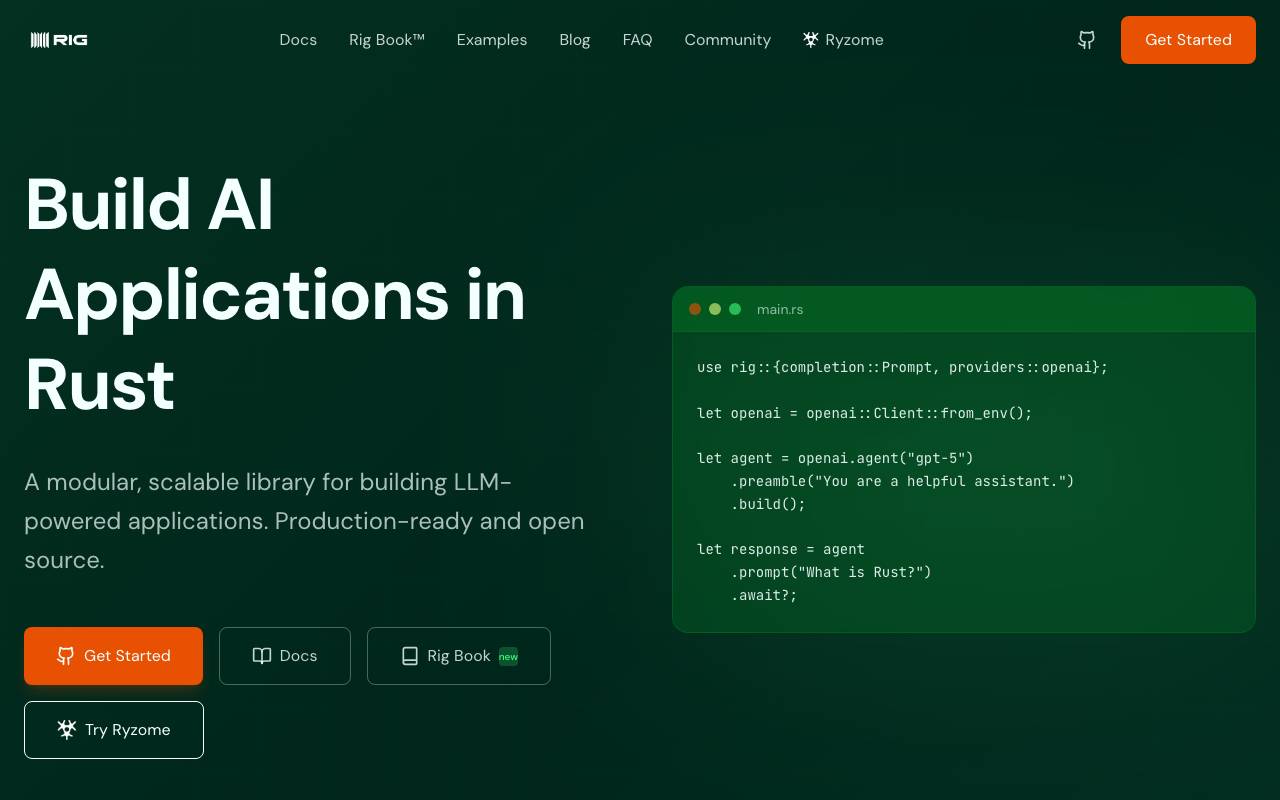
Rig is an open-source Rust library designed to help developers build applications powered by large language models. It provides unified abstractions over multiple LLM providers, embeddings, and vector stores, letting Rust engineers integrate AI capabilities without juggling provider-specific SDKs. The framework focuses on ergonomic, type-safe APIs for common patterns like completions, chat, RAG pipelines, and agent workflows. Because it's written in Rust, it appeals to teams that need performance, memory safety, and reliable concurrency in production AI services. Rig is suited for backend developers, infrastructure teams, and Rust shops looking to ship LLM features without leaving their preferred language ecosystem.
- Multi-provider LLM client abstractions
- Embeddings and vector store integrations
- Agent and tool-calling primitives
- RAG pipeline building blocks
- Async-first, type-safe API
- Open-source Rust crate

AI-Inspired packaging design
Generate custom packaging mockups from text prompts in seconds.

Pacdora's AI packaging design tool enables users to generate custom packaging mockups from text prompts in seconds. The platform integrates with over 6,000 hyper-realistic 3D mockups and utilizes AI to precisely capture design requirements. Users can choose a base mockup, describe their design idea, and refine individual elements until it's perfect. The generated designs can be directly used for product launches, client presentations, and even final manufacturing. The tool does not require design skills, making it accessible to users who want to unlock infinite packaging possibilities without learning complex software. Pacdora AI handles technical complexities, including functional details like box opening and closing mechanics, and adds realistic lighting effects. The platform supports a complete design workflow, including packaging, backgrounds, and scenes, delivering a one-stop creative solution.
- Text-to-image packaging generation
- Multiple style variations per prompt
- Quick iteration on concepts
- Free starter credits
- Suitable for diverse product categories
- Browser-based access

Haystack
Open-source Python framework for building LLM and RAG applications in production.
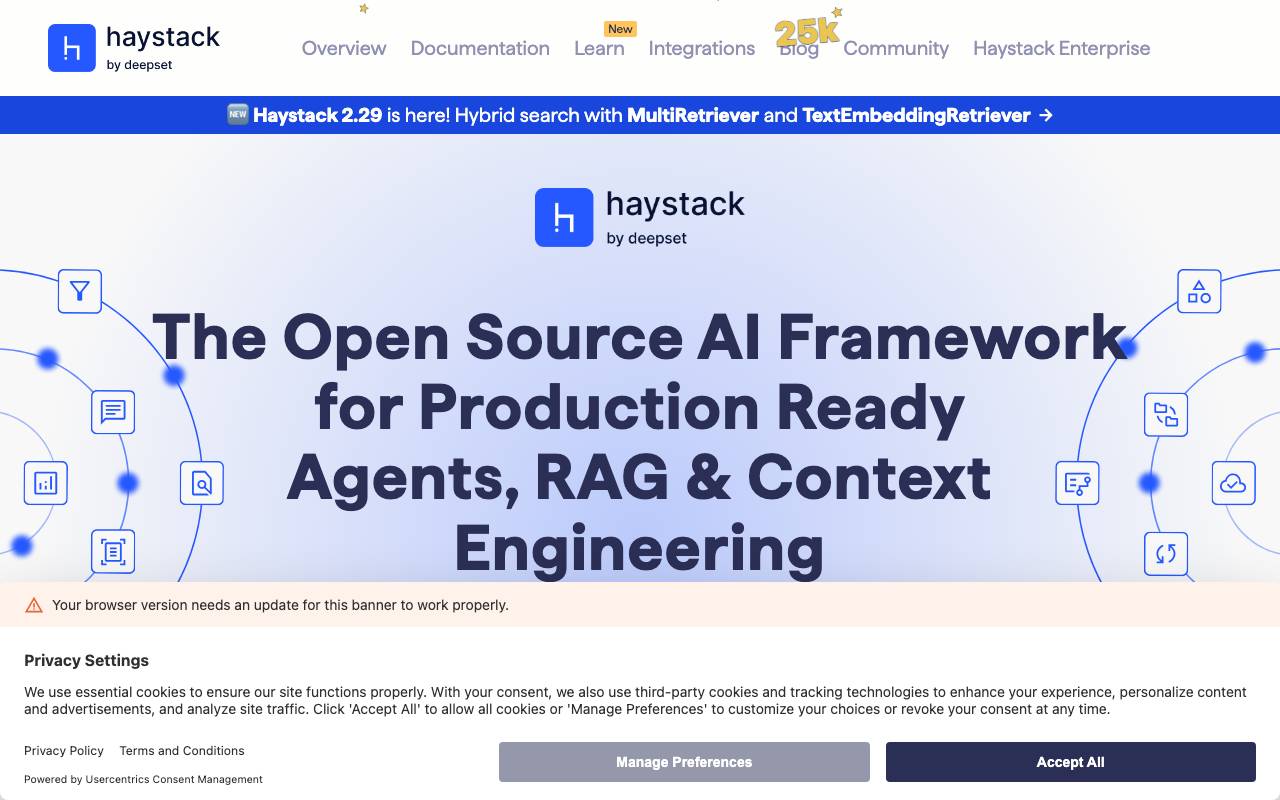
Haystack is an open-source framework from deepset for building applications powered by large language models and retrieval-augmented generation. It provides a modular, pipeline-based architecture that lets developers connect components like document stores, retrievers, rankers, and LLMs to create search, question answering, and agentic workflows. The framework integrates with popular model providers, vector databases, and tooling ecosystems, making it suitable for both experimentation and production deployment. Teams can prototype with simple pipelines and scale up to complex multi-step flows involving tools, memory, and custom logic. With a focus on flexibility and observability, Haystack is widely used by developers building enterprise search, chatbots, and document intelligence systems on top of their own data.
- Composable pipelines for RAG and search
- Support for major LLM and embedding providers
- Connectors for vector and document stores
- Agents and tool-calling capabilities
- Evaluation and monitoring utilities
- Deployment-ready REST API options
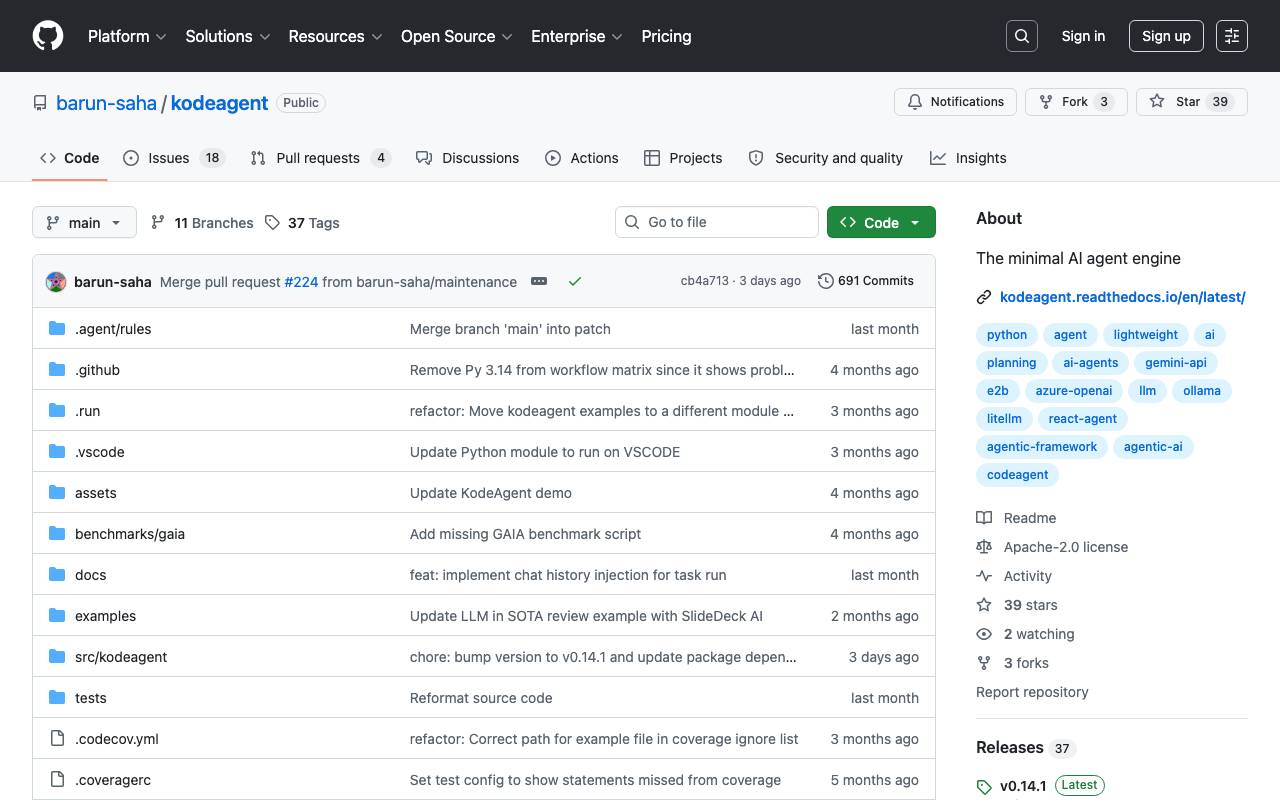
KodeAgent is a compact agent framework designed for developers who want a clear, no-frills foundation for building AI-powered agents. It strips away unnecessary abstractions, exposing the core loop of reasoning, tool use, and action so engineers can understand and customize every step. Because it stays small, KodeAgent is well suited to prototyping, learning agent internals, or embedding agent behavior into larger applications without pulling in a heavy dependency tree. Developers can wire in their own LLMs, tools, and memory backends as needed. It targets technical users comfortable with code-first workflows rather than visual builders, making it a good fit for teams that prefer transparent, extensible building blocks over opinionated platforms.
- Lightweight agent runtime
- Pluggable LLM backends
- Custom tool integration
- Reasoning and action loop
- Developer-focused API
- Suitable for embedding in apps

Montoyer Agents
Multi-agent AI framework specialized in EU policy, law, and institutional procedure.

Montoyer Agents is a multi-agent framework built to navigate the complexity of European Union policymaking. It coordinates specialized AI agents that can research legislation, trace institutional procedures, and synthesize positions across the Commission, Parliament, and Council. The system is designed for public affairs professionals, legal analysts, and policy researchers who need structured, source-aware outputs rather than generic chatbot answers. Agents can be orchestrated to monitor files, draft briefings, compare directives, or map stakeholder positions on a given dossier. By focusing narrowly on the EU institutional context, Montoyer Agents aims to reduce hallucinations common in general-purpose models when handling procedural nuance, comitology, or trilogue dynamics.
- Specialized agents for policy and legal research
- EU legislative procedure awareness
- Stakeholder and position mapping
- Automated briefing and memo drafting
- Multi-source document synthesis
- Workflow orchestration across agents

upsonicAI
Open-source agent framework for building task-focused digital workers and vertical AI agents.
upsonicAI is a developer framework designed for creating AI agents that handle specific business tasks rather than open-ended chat. It emphasizes a task-oriented approach, letting teams define discrete jobs, tools, and outputs that agents are expected to deliver reliably. The framework targets vertical use cases such as research assistants, sales operations, customer support workflows, and other digital worker roles. It integrates with common LLM providers and tooling ecosystems, allowing developers to compose agents with structured inputs, verifiable outputs, and reusable components. Because it is open source, upsonicAI is well suited for teams that want self-hosted control over agent logic, observability, and deployment rather than relying on a closed platform.
- Task-oriented agent architecture
- Structured input and output handling
- Tool and function integration
- Multi-LLM provider support
- Components for vertical AI agents
- Self-hosting and customization