Best AI Model Serving Platforms (2026)

If you sign up through a link on this page, we may earn a commission — it never affects our rankings.
A curated guide to platforms for deploying, scaling, and managing machine learning models in production, covering hosted inference services, open-source serving frameworks, and GPU-optimized runtimes.
AI Model Serving Platforms by the numbers
Pricing mix
Best AI Model Serving Platforms (2026)
- 1
 PineconeFully managed vector database for real-time semantic search in AI applications4.8 (6)
 - 2
 GLM‑4.5Open-source hybrid-reasoning MoE foundation model built for agentic, coding, and tool-use tasks4.5 (6)
 - 3
 AstrolabeSelf-hosted OpenAI-compatible routing gateway for OpenClaw agents with cost and safety policy4.4 (5)
 - 4
 New APIOpen-source LLM gateway unifying multiple AI provider APIs with routing, billing, and analytics4.3 (4)
 - 5
 Jina AIMultimodal search foundation for embeddings, reranking, and RAG pipelines.4.2 (5)

Pinecone
Fully managed vector database for real-time semantic search in AI applications
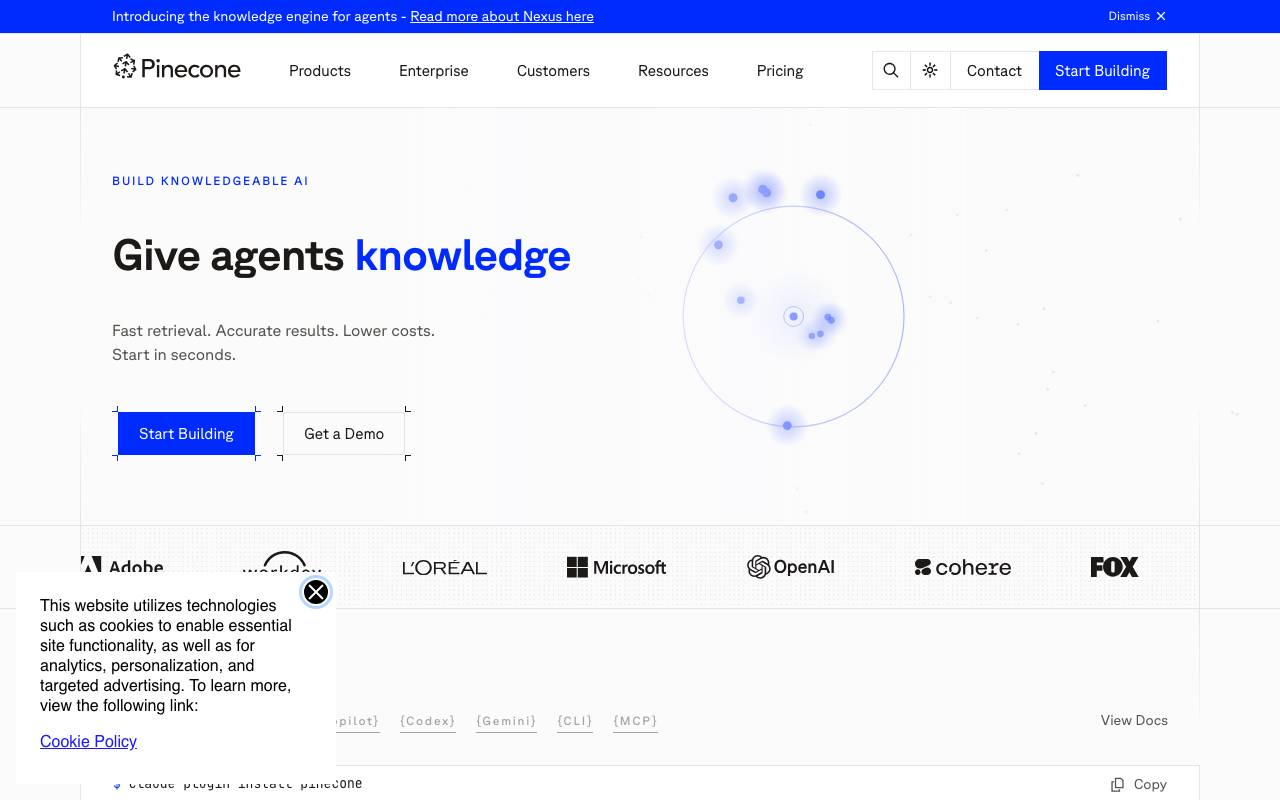
Pinecone is a fully managed vector database designed for AI applications that rely on semantic search and retrieval. It stores high-dimensional vector embeddings and lets developers query them by similarity, returning the most relevant results for tasks like retrieval-augmented generation (RAG), recommendation, and AI agent memory. The service abstracts away the operational complexity of running a vector index at scale. The core problem it addresses is making large volumes of embedding data instantly searchable without requiring teams to manage infrastructure, tune indexing algorithms, or worry about scaling. According to Pinecone, writes are acknowledged in under 100ms and become searchable within seconds, indexing is automatic with algorithms selected per data size, and query latency stays consistent as data grows because all data is searched in parallel. Pinecone is aimed at developers and engineering teams building AI features—from startups prototyping a search feature to enterprises deploying production AI. Users create indexes (organized into namespaces) that hold dense vectors of a chosen dimensionality, then perform upsert, query, fetch, update, and delete operations through APIs or a web console. The platform reports usage in read and write units, reflecting a consumption-based pricing model. Beyond the core database, Pinecone offers components such as Assistant and Inference, along with a management console (app.pinecone.io) for monitoring metrics like read/write units, request latency percentiles, storage size, and record counts. Indexes can be deployed across regions and cloud providers (e.g., AWS us-east-1, us-west-2, eu-west-1). For enterprise customers, Pinecone provides security and compliance features including encryption at rest and in transit, SSO, RBAC, customer-managed encryption keys, and private networking, plus SOC 2 Type II, HIPAA, GDPR, and ISO 27001 certifications, uptime and support SLAs, and dedicated customer success. Pinecone competes with other vector databases and search systems such as Weaviate, Milvus, Qdrant, and pgvector. Its main differentiator is the fully managed, serverless-style approach that removes index tuning and infrastructure management, though this comes at the cost of less control over the underlying engine and potential vendor lock-in compared to self-hosted open-source alternatives.
- Managed dense vector storage and similarity search
- Automatic, continuous indexing and rebalancing
- Namespaces for partitioning data within an index
- Multi-region and multi-cloud index deployment
- Monitoring console with latency, throughput, and storage metrics
- Assistant and Inference components for AI workflows

GLM‑4.5
Open-source hybrid-reasoning MoE foundation model built for agentic, coding, and tool-use tasks
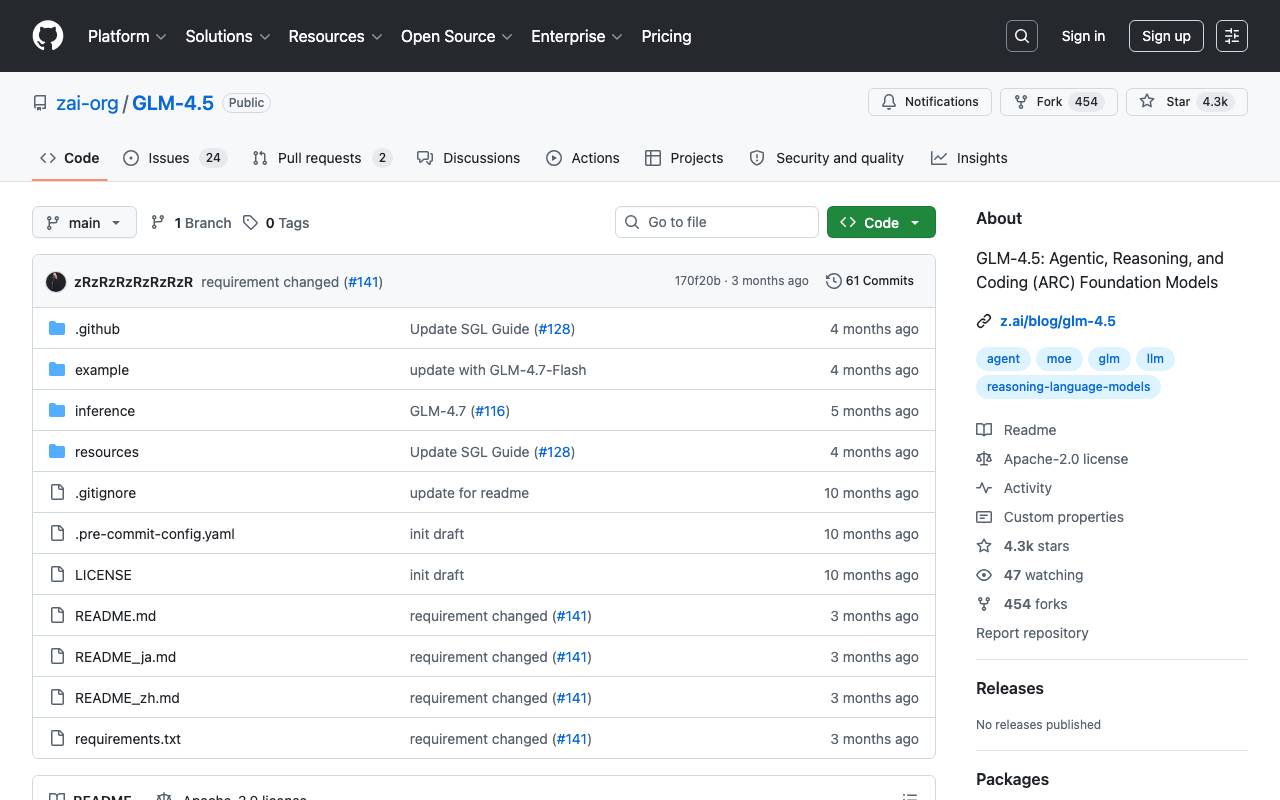
GLM-4.5 is an open-source large language model developed by Zhipu AI (Z.ai) as part of the GLM model family. It uses a Mixture-of-Experts (MoE) architecture and a hybrid-reasoning design that lets the model either "think" before responding or answer directly, targeting agentic workflows, coding, and tool use. The model supports a 128K-token context window and native tool calling. The model is positioned for developers building AI agents and coding assistants. It introduced "Interleaved Thinking," where the model reasons before each response and tool call, which later GLM releases (GLM-4.6 and GLM-4.7) extended with features like Preserved Thinking and Turn-level Thinking. GLM-4.5 emphasizes agentic coding, integrating with mainstream agent frameworks and coding tools such as Claude Code, Cline, Roo Code, and Kilo Code. The GitHub repository hosts model resources, inference code, and examples, while the weights are released openly for self-hosting and the API is offered through the Z.ai API Platform. The repository now also documents successor models GLM-4.6 (expanding context to 200K tokens) and GLM-4.7, alongside a lightweight 30B-A3B variant (GLM-4.7-Flash) for more efficient deployment. As an open-weight release, GLM-4.5 competes with other open models aimed at agentic and coding use cases. Its strengths lie in tool use, reasoning control, and openness, though running a large MoE model locally requires substantial hardware, and newer GLM versions have since superseded it on benchmarks.
- Mixture-of-Experts (MoE) architecture
- Hybrid reasoning with thinking/non-thinking modes
- Native tool calling for agents
- Interleaved thinking before responses and tool calls
- 128K context window
- Agentic coding optimization

Astrolabe
Self-hosted OpenAI-compatible routing gateway for OpenClaw agents with cost and safety policy
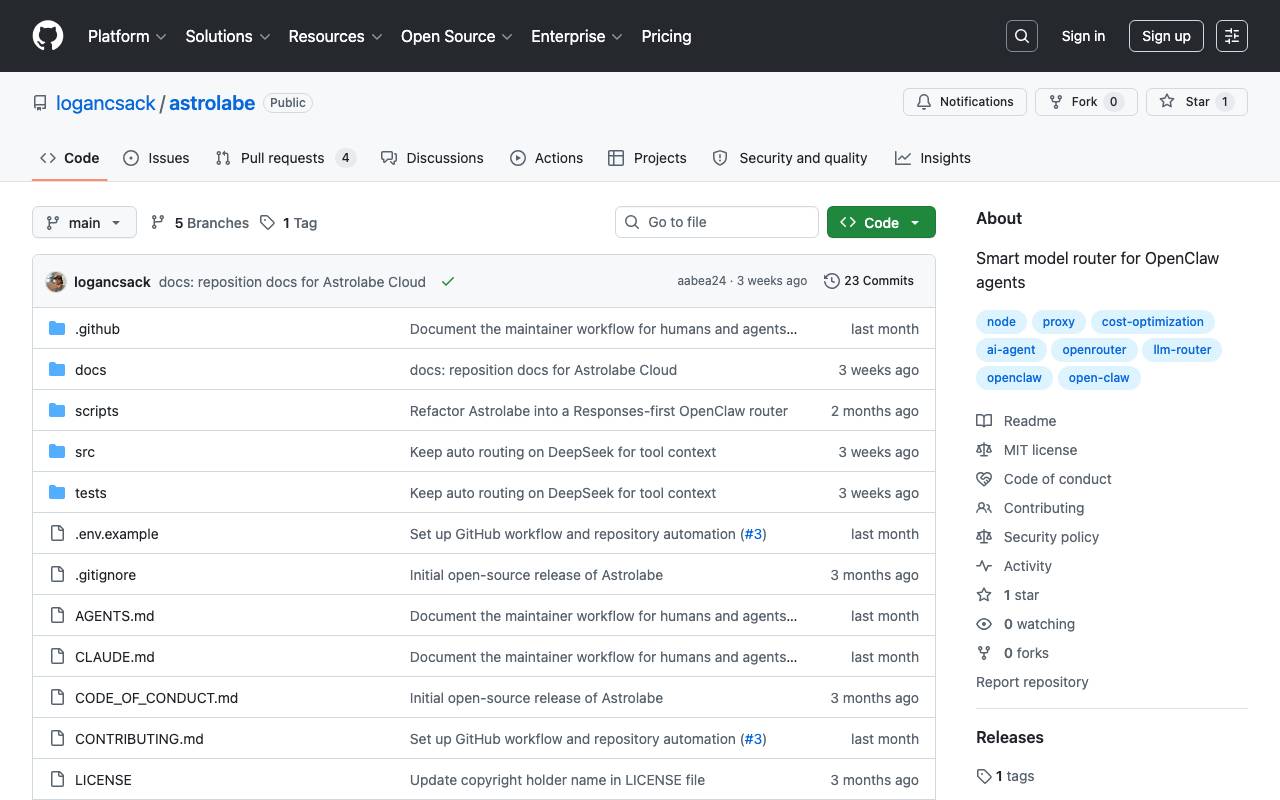
Astrolabe is an open-source AI gateway designed to sit between OpenClaw agents and OpenRouter. It acts as a routing proxy that classifies each request, resolves an appropriate model lane from a static checked-in roster, executes the call against OpenRouter, and applies safety policy around tool use and untrusted inputs. The goal is to let self-hosted agents avoid hand-tuning providers and model IDs on a turn-by-turn basis. The project exposes a set of virtual models such as astrolabe/auto, astrolabe/coding, astrolabe/research, astrolabe/vision, astrolabe/strict-json, astrolabe/cheap, and astrolabe/safe. These map to concrete underlying models from providers like DeepSeek, OpenAI, Anthropic, MiniMax, Moonshot, xAI, Qwen, Google, and Mistral, which are maintained in static manifests rather than a hardcoded configuration object. Astrolabe centralizes four concerns for OpenClaw agents: routing flexibility, reliability and fallback behavior, cost control, and safety policy for tool use. It is intended to deliver these without adding a database, a hosted control plane, or any SaaS dependency. The OSS version is stateless and self-hosted; the operator supplies their own OpenRouter API key and an Astrolabe API key, then points OpenClaw at the Astrolabe instance. At runtime, OpenClaw sends a request to Astrolabe's POST /v1/responses endpoint (with POST /v1/chat/completions retained as a compatibility adapter). Astrolabe classifies category, complexity, and modifiers, resolves a lane and candidate model set, runs the request, verifies non-streaming responses, applies tool policy checks, and may escalate once to a stronger model. It returns the upstream response along with x-astrolabe-* headers and inline metadata. As of version 0.3.0 Beta, the project is early-stage and small. It is purpose-built for the OpenClaw ecosystem rather than as a general-purpose LLM gateway, so users outside that workflow may find more mature alternatives in tools like LiteLLM or OpenRouter's own routing. Its static, checked-in model roster gives reproducibility but requires manual updates as models change.
- OpenAI-compatible /v1/responses and /v1/chat/completions endpoints
- Static checked-in model manifests across multiple providers
- Virtual model lanes (auto, coding, research, vision, cheap, safe, strict-json)
- Request classification by category, complexity, and modifiers
- Tool-use safety policy checks with single escalation
- Response verification and x-astrolabe-* metadata headers

New API
Open-source LLM gateway unifying multiple AI provider APIs with routing, billing, and analytics
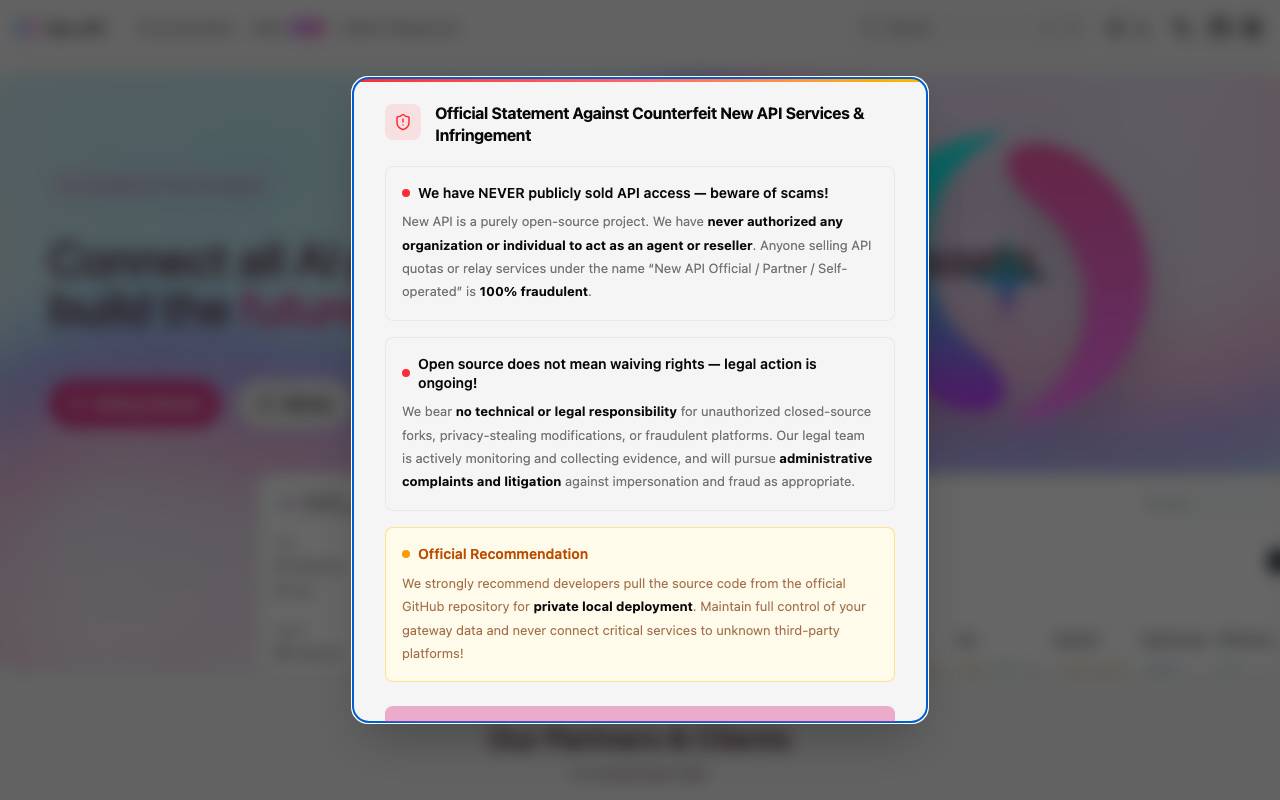
New API is an open-source LLM gateway that provides a unified interface for connecting to multiple AI model providers, including OpenAI, Anthropic Claude, and Google Gemini-style APIs. It acts as a central management layer that lets teams route requests across providers, control access, and track usage from one place. The project is aimed at developers, platform teams, and organizations that consume AI APIs at scale and want a single gateway rather than integrating each provider separately. By exposing OpenAI-compatible endpoints, it allows existing applications and SDKs to work with many backends without rewriting client code. Beyond basic proxying, New API focuses on operational concerns such as token-based quotas, billing and credit management, request auditing, and usage analytics. These features make it suitable for building internal AI platforms or reselling/metering access to multiple users or teams. As an open-source, self-hostable tool, it gives operators control over deployment and data flow, which can be important for cost management and compliance. It positions itself in the same space as other API gateways and aggregators like LiteLLM and One API, from which it derives. As with most self-hosted gateways, adopting New API requires infrastructure setup and ongoing maintenance, and the breadth of provider support and stability depend on community contributions.
- Unified multi-provider API gateway
- OpenAI-compatible endpoints
- Request routing across model providers
- Token quotas and billing management
- Usage analytics and auditing


Jina AI provides a suite of foundation models and APIs built around search, retrieval, and multimodal understanding. Its core offerings include text and image embeddings, neural rerankers, zero-shot classifiers, and tools for building retrieval-augmented generation (RAG) workflows at scale. The platform is designed for developers and teams building search engines, recommendation systems, and AI assistants that need to reason across text, images, and structured data. Models are accessible through hosted APIs and open-source releases, with multilingual support and long-context capabilities for handling large documents. Jina AI integrates with common vector databases and LLM frameworks, making it a practical building block for production-grade semantic search and knowledge retrieval systems.
- Text and image embedding models
- Neural reranker APIs
- Zero-shot classification
- Long-context document support
- Multilingual retrieval
- RAG and vector database integrations
Browse all 5 AI Model Serving Platforms tools
The complete, searchable directory — ranked by real user reviews.


